According to seventeenth century master astrologer William Lilly, working out the temperament was the first and most important step of natal judgment. In my quest to learn and capture the insights temperaments gave our astrological forefather, I came upon the notion of identifying the significator of manner as a crucial step in understanding how the temperament would manifest in the life.
Working with temperaments alone, gives us limited information, but identifying the planet that signifies the ‘manner’ seems to unlock the secret of how an individual basic nature will manifest. The significator of manner was also referred to by other authors as the quality of the soul. The temperament shows us the innate nature of an individual whilst the quality of the soul or manner, show us what they want or choose to become.
The significator of manner was identified by William Lilly as either a planet in the 1st house in the same sign as the ASC, a planet conjunct or in partile (to the degree) aspect with Moon or Mercury, ruler of the ASC if aspected by one of his rulers or finally if no planet fits any of the above conditions you would judge the planet with the most essential dignity at the degree of the Moon and Mercury to be the significator of manner, that is the planet through which the temperament is expressed. It is important to note how the planet signifying manner is configured in the chart, what it rules, aspects and its dispositor.
The catch was that only Mercury, Venus, Mars, Jupiter and Saturn seemed to be eligible for the role of significator of manner. The luminairies and the outer planets (unknown in Lilly’s time) modify the planet(s) of manner and add much to the story it tells, but can not function alone.
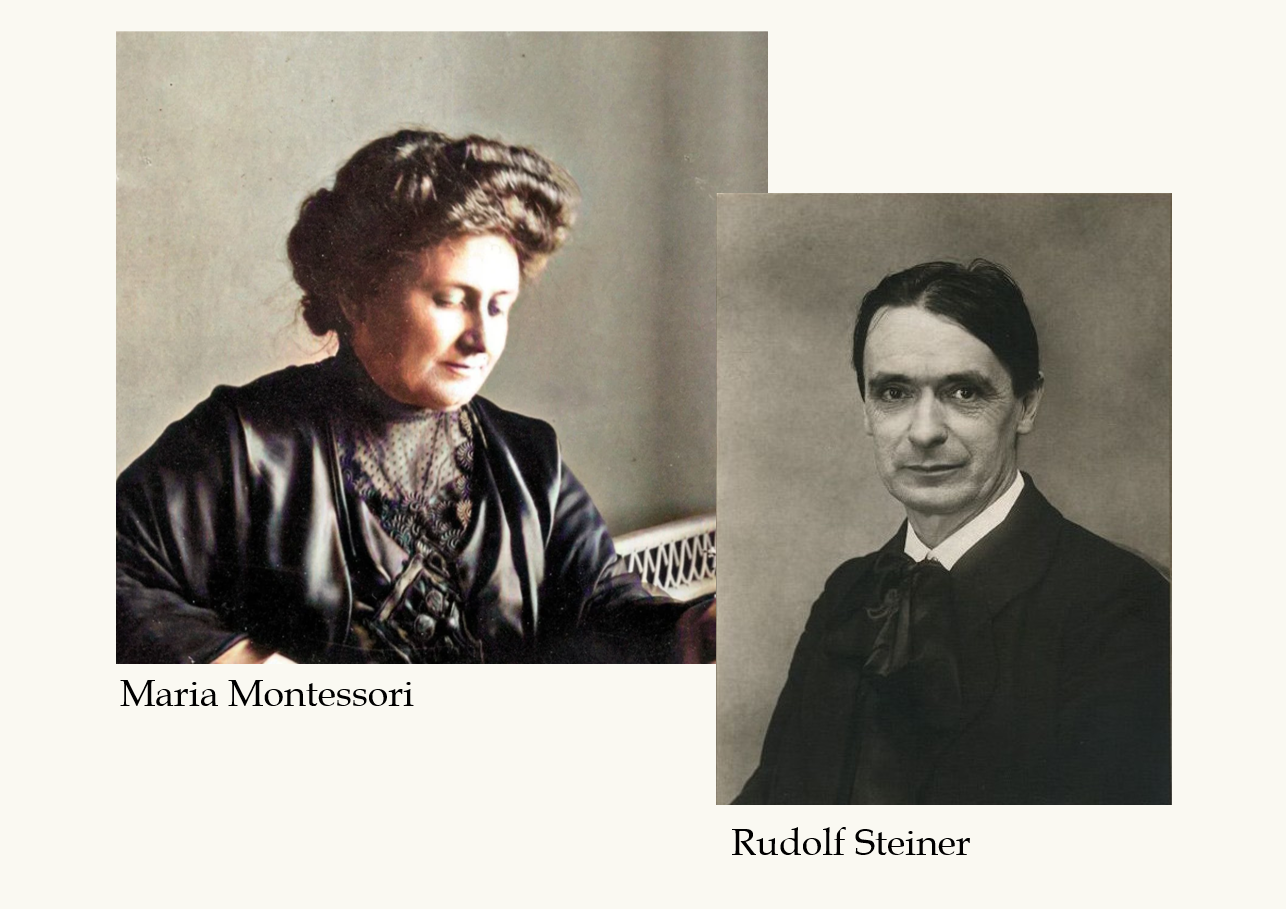
That a person’s life work reflects their nature should be a given, after all we can not divorce ourselves from who we are (no matter how hard we may try). Looking at the two educational methods that are Maria Montessori’s and Rudolf Steiner’s legacies we should be able to recognize their founders imprint.
In particular will the basic nature of these gifted individuals as defined by their temperament and the planet that signifies their manner, be reflected in their educational method?
A brief overview of the two educational methods
Maria Montessori developed her method of education through the observation of children rather then by the application of theories. Her medical and academic training allowed her to approach her work in a very structured and intellectual manner. She observed the child’s innate ability and joy in learning and understood it to be a natural result of a child’s interaction with his environment. Many of Montessori’s then radical ideas about children and their education have now become part of the excepted norm. Whilst Maria Montessori focused her entire working life on education, Rudolf Steiner was far more eclectic. He was a visionary and came to his development as an educator through his profound understanding and experience of the spiritual nature of the world and man. His point was to nurture the spiritual development of the child and to allow it to unfold free from adult (and therefore corrupted) interference.
Both systems have similarities, in that the respect of the child’s ability to learn is paramount and that the learning environment is child centered and focused. Both maintained that children learn only when treated with respect and in a nurturing environment. Both also contained an element of idealism, believing that through the child the world could be changed.
Briefly, the Montessori system emphasizes the prepared and ordered environment in which the child is free to explore, naturally learning through his senses, beginning from the concrete evolving to the abstract. The Montessori system believes that the child’s innate desire to learn will lead him to naturally acquire the skills needed at the point when he is ready. Montessori discourages the exposure to fantasy and fairy tales, believing this to confuse the child and that the “real” world was fascinating enough.
The Steiner method on the other hand encourages imagination and believes that the child comes to understand the nature of the world through colour, play and myth. The Steiner method emphasizes the spiritual nature of the child and encourages its expression through movement, storytelling and play. They advocate not exposing children to the academic subject until the age of eight.
Maria Montessori – her life and work
Maria Montessori was born in Italy on Aug 31, 1870. As a child she showed a great interest and aptitude to study and was encouraged by her mother to pursue an academic career. After many difficulties and restrictions she became the first woman in Italy to qualify as a medical doctor. She later went back to school to study psychology and philosophy. In 1904, she was made a professor of anthropology at the University of Rome. She gave up both her medical and academic career in 1906 to focus on the education of children full time. Until her death in 1952 she travelled the world revolutionising pedagogy.
Her personal life was more austere. She had a son, Mario, with a colleague, Doctor Montesano, the couple never married. It was said that Maria and Montesano agreed to never marry, but eventually Montesano reneged on his part and married someone else. Mario was raised by a family in the countryside of Rome and his mother would visit him sporadically.
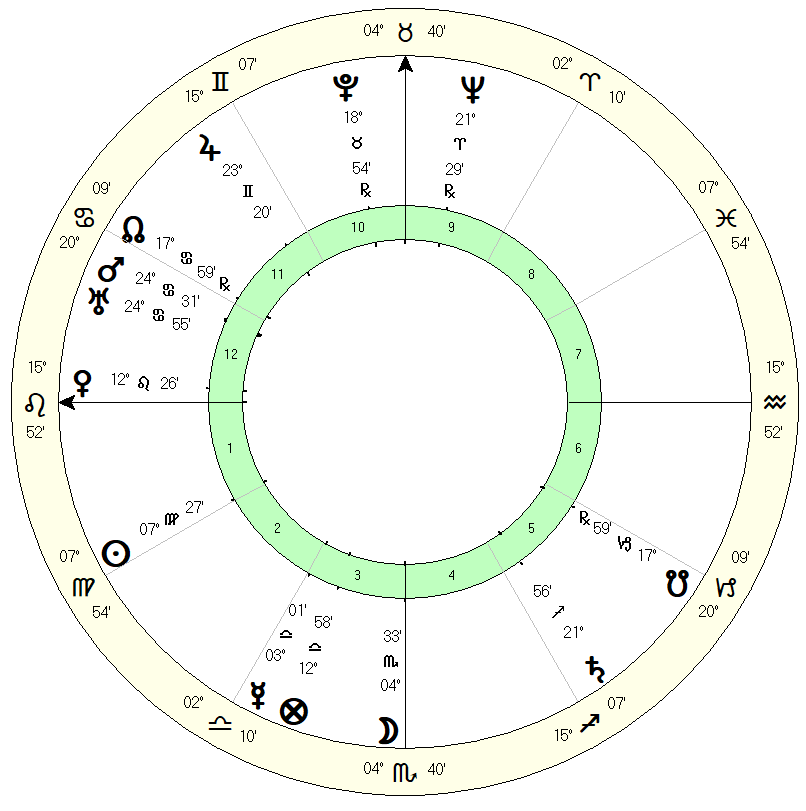
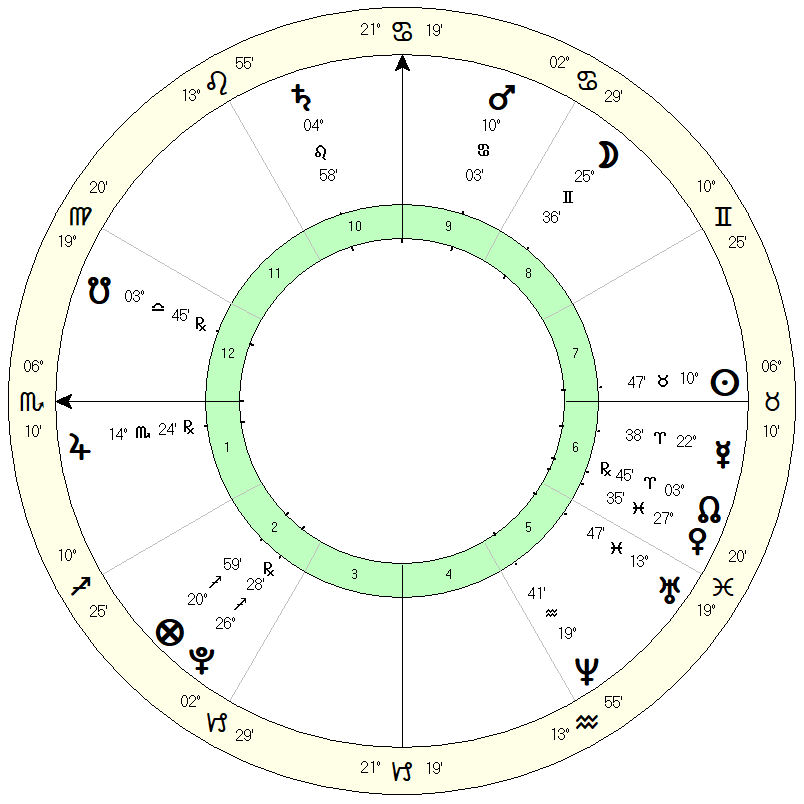
Judging her temperamental nature through her natal chart we find a woman whose more external nature (ASC and Sun) were predominantly Choleric (hot and dry), and a bit Phlegmatic (cold, moist). This means that her natural inclination was to expand and move outwards (hot) and be very structured and defined. There can be a tendency for Choleric people to be dogmatic and stubborn and if biographical reports are to be believed, this was a part of her character. The Phlegmatic quality resided entirely in her Scorpio Moon conjunct her IC (foundations) and ruling her 12th house.
Identifying the significator of her manner, the planet through which her nature is focused, we find that Venus is in her 1st house in the ASC sign of Leo in antiscia conjunction to Pluto in the 10th house.
Venus is powerfully positioned on her ASC and rules her MC, 3rd house as well as Mercury (conjunct the 3rd cusp). Clearly we see career coupled with early learning and children (Mercury, natural ruler of children, despositor of the 5th house ruler Jupiter and PoF in Gemini). Her choleric nature was most clearly expressed in these realms of life through powerfully placed Sanguine Venus, helping to temper her overly choleric nature. Coupled with the influence of powerbroker Pluto, we can symbolically see the incredible transformation of childhood education that she accomplished.
The phlegmatic part of her nature resides entirely in her Scorpion Moon and was ruled by Mars in all dignities: domicile, triplicity, term and face. We could judge Mars as a secondary significator of manner. Mars himself is in the phlegmatic sign of Cancer (in mutual reception with her Moon in Scorpio) and conjunct Uranus. Today we may forget how radical some of her ideas about children and education were, and how radical her private life was for its times.
There is idealism in her educational philosophy that can be seen in the partile trine between her 9th house Neptune and 5th house Saturn: idealizing the structure of the environment. Neptune is also squaring her Mars and is in antiscia conjunction with her natal Sun.
The relative positions of Venus and Mars in regards to the ASC indicate that Mars came to the forefront later, when by direction the ASC and Mars had conjoined, at about the age of 21/22 when she began to fight to attend medical school. This was a woman who fought for and won everything she achieved in her life, beginning with her conservative father, the authorities at University and later other educationalists. Mars rules her foundation and father (4th house) and higher education (9th house). Privately, her life was not as successful as her career. She had a child out of wedlock (5th ruler Jupiter is in detriment) who was raised by another family and she never married. Her personal fights may have ended in a far more phlegmatic manner then her public ones.
Rudolf Steiner – his life and work
Rudolf Steiner was born into a stable working class family. From a very young age Rudolf was aware of things unseen. As a boy he showed such intelligence and eagerness to learn that his father arranged for him to be educated. Steiner studied far more subjects then was required, doing outside reading on subjects as philosophy, psychology, science and geometry. He was inspired by Goethe, who he recognized as one who perceived the spiritual in Nature. Eventually Steiner founded the Anthropophy society (a break away faction of the Theosophical movement with more emphasise on the Western mystical tradition, rather then the eastern bent of the Theosophist).
Unlike Montessori, Steiner did not dedicate his life to education. He had a far more expansive palette of interests, drawn together by an overarching theme of societal transformation, society through the recognition and fostering of man’s spiritual nature. He was extremely prolific; writing some 33 books and delivering over 6000 lectures in his lifetime. The development of his educational ideas and founding of the Waldorf schools that bear his name, occurred later in life at the age of 57 at the instigation of friends.
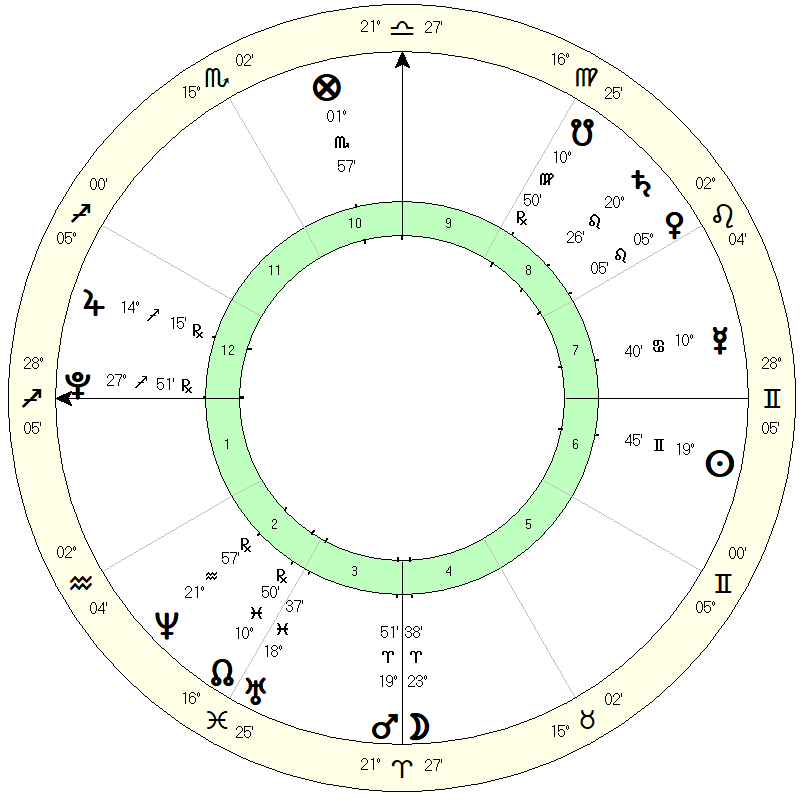
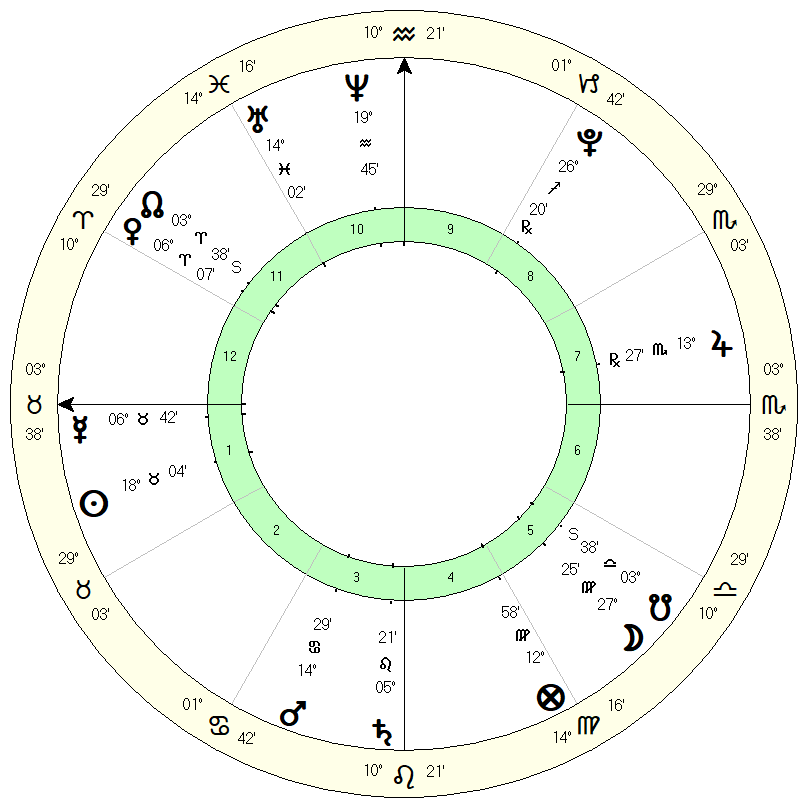
Rudolph Steiner’s chart indicates a Phlegmatic/Melancholic temperament giving him a predominately cold nature (with equal moist and dry). This means that his movement is down and inwards. This is a man who was able to spend much time alone and in contemplation. The moisture in his nature gave him the ability to connect things together whilst the dryness allowed him the ability to put structure to his insights.
As no planet was in the 1st house, no planet was in partile aspect or conjunction to either Moon or Mercury (though Neptune conjuncting Mercury will be a modifying influence), the ASC ruler Mars was not aspected by any of his rulers, we are left with Mercury as the planet with the most dignity at the Moon and Mercury degrees as the significator of manner. So his manner was signified by occidental therefore melancholic Mercury, conjunct Neptune in Pisces. The dispositor of both is Jupiter in Leo conjunct this MC. Jupiter is the universal significator of all things philosophical, religious and spiritual. This indicates that his nature was expressed through a dry mind that was able to perceive things unseen (Neptune). He would want or choose to communicate and share these perceptions with the world.
Mercury also tells us about the great variety and amount of interest and work he did. Mercury rules the 8th and 11th houses, Moon, Uranus and Saturn giving us further clues as to how and in what areas of life Steiner’s very cold, contemplative nature would be best expressed.
The Lunar contact, Moon is in opposition and is received by Mercury, supported by Neptuneconjunction, indicates the reflective nature of Steiner’s mind. Through his Moon, ruler of the traditional 9th house of dreams, philosophy and religion, his nature is drawn to the unseen. The Melancholic nature of his Moon (and Mercury) gives him the ability to structure his perception of the spiritual world. His desire to awaken humanity consciousness to the spiritual nature of life is clearly indicated by Mercury’s dominion over the 11th house of community and 8th house of death. After all we need to accept the death of the body before we can understand the life of the Soul.
The only heat in the temperament comes from his ASC ruler Mars. It is interesting to note that Pluto is conjunct ASC ruler Mars and is in almost perfect antiscia with MC. This allowed him to bring the energy and power (Mars conjunct Pluto) needed to project his work out to the world as he did.

 Astrologicalmind