Astrologicalmind

The magic of astrology explored

Tag: astrological philosophy

  • No Birth Time? What can the poor astrologer do?

    “…and the Chaldeans say that from eternity there has been a divine and intelligible stream through the eastern/rising part of heaven. And this stream both moves and turns the cosmos, and brings to life everything in it by sending them their own soul… And every degree, when it came to be around this eastern/rising place, which is the gate of souls and the spiritual inlet of the Universe, is made powerful.”     
    Porphyry: Introduction to Ptolemy (3rd century)


    The Prenatal Eclipse


    For years I have used the pre-natal eclipse chart with my clients. I cannot recall when I began to do so or for what reason. I do not differentiate between solar or lunar eclipse. I simply use the one closest to the birth date. Once I identify the eclipse, I locate it to the birth location. Over the years I have found that the degrees on the angles of these relocated pre-natal eclipse charts are sensitive and important. These degrees are so often highlighted in synastry, that I now expect them to be.

    Eclipses are true syzygy, which is defined in astronomical terms as: a roughly straight-line configuration of three or more celestial bodies in a gravitational system. An eclipse occurs when there is a lining up of the three main bodies in our astrological cosmos: Sun, Moon and Earth. These three bodies equate to spirit, soul and body. The moment of an eclipse is a moment of opportunity, as the three aspects of man, the three levels of existence align; allowing an exchange between them. The light of spirit can enter the soul/psyche and be received into the body, and vice-versa.

    The moment of an eclipse is anchored to the location from which it is experienced. This results in its manifestation being unique to both the location and the individual to whom the eclipse is connected. While everyone born in a location within a particular time frame will share the same pre-natal eclipse horoscope, the location of the planets on the day of their birth will be different.


    Discovery on a Whim


    George Perry Floyd woke up on the morning of May 25, 2020 an ordinary man, black in America; he did not wake up with the intention of making a mark on the world; nor did he wake up that day to die on the street under the knee of Derek Chauvin.

    Through his tragic death the importance of George Floyd’s life was elevated beyond his individual human experience, to become a powerful symbol, a talisman for change. The cruel and heartless criminality of his death held a mirror to all that is unjust and corrupt in our world. In death George Floyd left a mark on the world. I was intrigued as to what astrological signature might be in his chart indicating such exaltation in his death.

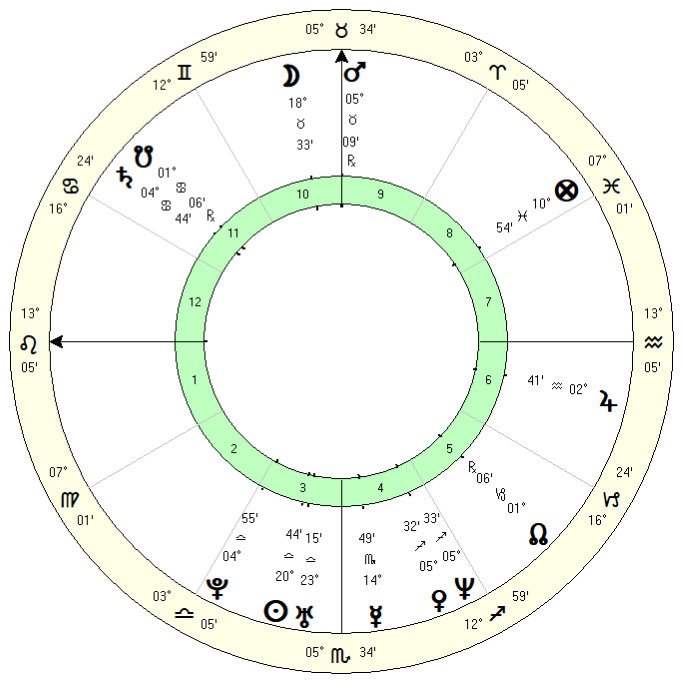
    George Floyd was born on October 14, 1973 in Fayetteville, North Carolina. There is no recorded birthtime for him. Frustrating as this was, I decided to explore his chart nonetheless. Setting it for noon confirmed that he had a Moon is in Taurus, but I could not identify any angles/houses meanings.

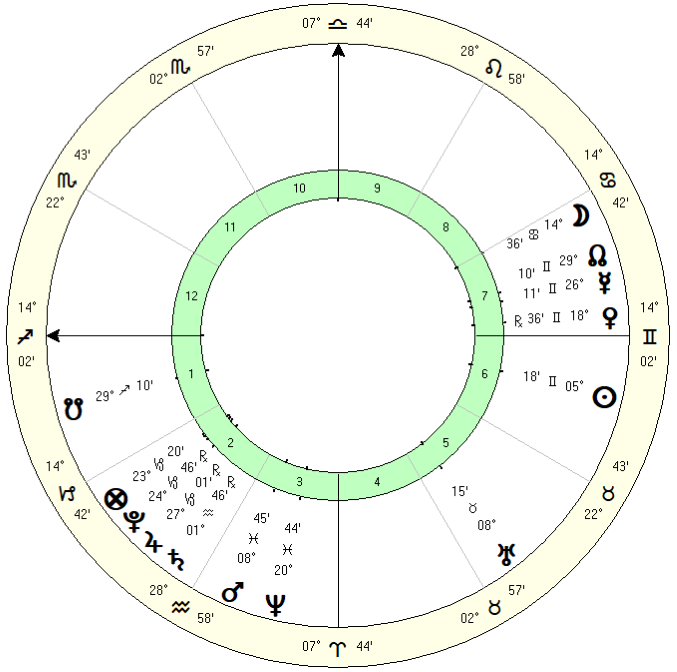
    I decided to look at the pre-natal eclipse chart which would have active angles and see if it might shed light on the manner of his death. The eclipse occurred on July 15, 1973; in Fayetteville NC it was at 7:56 am. It was a Lunar eclipse at 22 Capricorn. With 13’06” Leo on the ASC and 5’35” Taurus on the MC. I noted that the ruler of the eclipse degree, Saturn at 27 Gemini, was trining the USA (Sibley) chart’s Moon at 27 Aquarius, and was on the antiscia of the USA Venus at 3 Cancer.
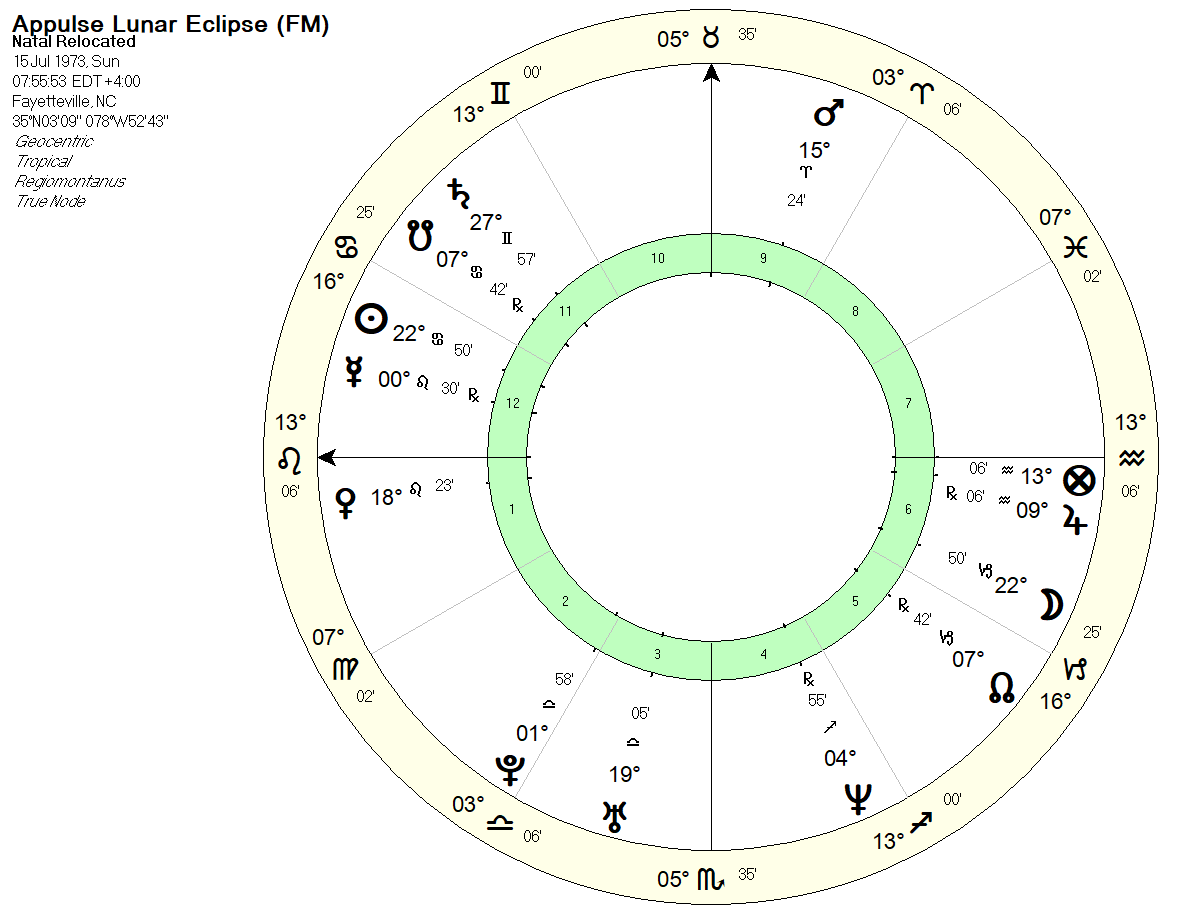


    George Floyd PNE Angles


    Oct 14 1973 in Fayetteville NC
    PNE angles giving a 1:58 AM time

    George Floyd’s Death


    May 25, 2020 at 21:25 CDT in Minneapolis, Minnesota

    Transits:


    1. Syzygy is a traditional astrological term that refers to the pre-natal lunation degree. Considered very important in delineation of a natal horoscope. ↩︎
    2. The Lot or Part of Fortune is a calculated point found by taking the distance between Sun and Moon and projecting it from the ASC. I personally use the fixed formula. ↩︎
    3. Planets in each other’s sign or exaltation, but not making an aspect. Sometimes falsely referred to as being in mutual reception. These planets are really in mutual disposition. ↩︎
    4. Each planet is in fall when in the sign opposite the sign of their exaltation; they also have a specific degree that is said to be their degree of fall, which is opposite their degree of exaltation. Jupiter’s degree of exaltation is 27 Cancer, so 27 Capricorn is its degree of fall. ↩︎
  • What is a Horoscope? (a short philosophical digression)

    A horoscope is a map of the heavens, taken at a specific moment & place on earth; showing the relative positions of the Sun, Moon, planets, the ASC & midheaven in the degrees of the zodiac. A horoscope captures & anchors a moment, crystallizing it into a symbolic framework that provides a wealth of information. It is made up of three principal ingredients: the signs, planets and angles/houses. Each are of equal importance, symbolically defining and providing information on different: types of time and levels of existence.


    A very brief look at levels of time


    Looking at these three principal ingredients through the lens of time, we find that the signs of the zodiac are in essence timeless, they exist beyond linear time as we know it.

    The signs do not define periods time. While you may consider that zero degrees of the cardinal sign heralds the beginning of a new season, it is not so. Rather it is the Sun’s entrance into the cardinal signs that defines the seasonal division of time. The meaning of the signs is wholly symbolic and only activated when visited by a planet, at which point that planet begins to express its nature through the prism of that sign. The symbolism of the signs is not based on time; it is we who project our lived experience of the cycles of life onto them.

    Planets represent both real & symbolic time. As they travel through their diurnal and zodiacal path, each planet divides time in its own proportion, creating infinite interweaving real time cycles (the bread & butter of an astrologers trade). Via diurnal motion the Sun divides time into days and its journey through the Zodiac defines the years. The return of planets to a particular degree happens in a predictable real time.

    The movement of planets can also represent symbolic time. The degrees a planet travels may be taken to symbolically represent a particular unit of time; such as a planets movement in a day representing a year in secondary progression, or primary directions where a planets movement by diurnal motion over 4 minutes1 will equate to a year in the life.  Fidarias2 and other ‘time lord’ methods, divides the life into planetary periods, derived from their mundane time cycle, but used symbolically to designate unfolding periods in the life of an individual.

    The angles represent real timeand define how strongly the planets in signs will be manifested in our individual human life. When things will manifest lies with the movement of the planets. The ASC is the degree that dictates the other angles, for these are fixed to the location. The angles literally represent time over a 24-hour period.

    In summary: the signs of the zodiac are timeless; the planets divide life in real time movement & cycles and symbolic time through progression, planetary periods and such; the angles and houses define real experienced time.


    Even briefer look at level of existence


    In many of the world’s traditions, the universe, life itself was understood as existing on three levels or parts: the holy trinity3, the three parts of Hermetic wisdom4 and Plato’s theory of the tripartite soul5. This was envisioned as a triangle divided into three levels of existences, or divisions of the Universe.

    Looking at the three ingredients through level of existence we find that the top most section which represents the unchanging world of primary cause: the non-material, divine realm, the source from which everything emanates; this is best expressed by the signs, as the signs do not vary their nature.

    The middle section represents the in-between world of secondary cause:the world of elements, soul6 or psyche, which is best expressed by the planets who vary their expression and present different facets of their nature as they move through the signs of the zodiac and in their individual synodic cycle.

    While the base section represents the world of laws, the manifested, complex & everchanging, material world we inhabit.  This is expressed by the angles and houses, which represents the various areas of our everyday experience of life in this world.


    Sun, Moon & Earth


    The most important bodies in our astrology are: Sun, Moon and Earth (angles). They represent the tripartite nature of human beings; the three level of soul7; which are associated with the three levels of existence (spirit, soul or psyche and body).

    Spirit related to inspiration. This is the human or rational soul, and is what we aspire to. It is consciousness. The unified divine aspect of self, shared by all humanity. It is represented by theSUN in the chart and is symbolised by the Circle which has no beginning nor end.

    Soul or psyche related to emotions. This is the animal soul; it is what moves and drives us. It is our senses (sight, smell, hearing, touch & taste), our feelings, instinct and emotions. This is the individuated aspect of self, that distinguishes us from each other.  It is represented by the MOON in the chart and is symbolised by the Crescent, the alembic that holds spirit giving it context and definition.

    Body related to matter and physical existence. This is the vegetative soul; it is the physical body through which we experience life. It is the biological functions and innate, non-rational intelligence of our body. It is represented by EARTH/the angles in the chart and is symbolised by the Cross of matter that anchors and manifests spirit in the physical world.


    1. Primary direction is based on the ascensional rising times of the signs over the ASC which varies according to location and seasons. ↩︎
    2. Firdaria are a system of planetary periods much like the dasa systems of India.  Each period of life falls under rulership of the classic seven planets and Nodes. ↩︎
    3. Holy Trinity—Wisdom (Word), Intelligence (Holy Spirit) and Power (Source). In the Christian faith these are associated with God the father, the son and the Holy Spirit. ↩︎
    4. Hermes ‘Trismegistus’ (thrice great) said to know the three parts of the wisdom of the whole Universe They are referred to as Alchemy, Astrology, and Theurgy, which are also known as the Operation of the Sun, the Operation of the Moon and the Operation of the Stars respectively.  ↩︎
    5. The Platonic soul consists of three parts, which are located in different regions of the body: logos (reason) located in the head; thymos (spirit/emotions) located in the chest/ heart area and Eros (desire) located in the stomach. ↩︎
    6. The term ‘soul’ can be problematic as it is defined and conceived differently by many and leads to complex theological debates. For clarity I define soul as a non-individuated essence that is the interface between Spirit and matter, connecting our earthly being to a higher power. My understanding is that soul exists in all things on different levels. Where there is life there is soul. (see note 4) ↩︎
    7. The human or rational soul; animal soul and vegetative soul. (See note 4) ↩︎
  • Saturn: the great malefic or the astrologer’s friend?

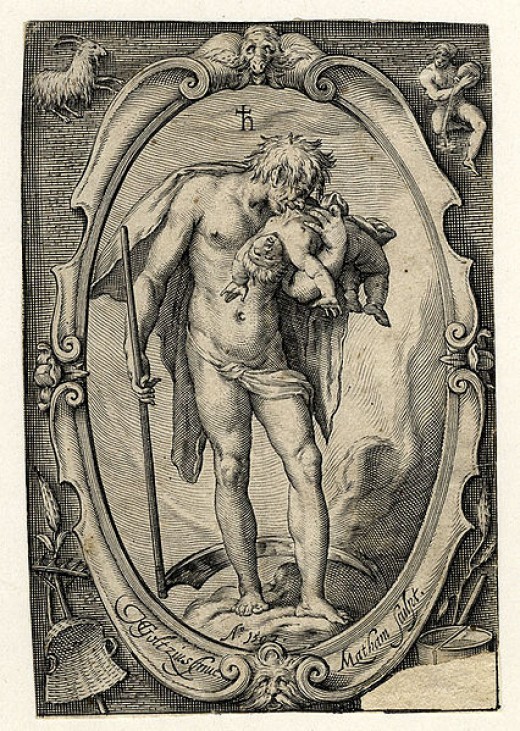
    Traditional astrologers viewed the planets quite differently than how we understand them today. They understood the planets to be living conscious beings, or as 12th century Guido Bonatti called them: superior beings.

     “…On those things which move a man to pose a question. The first is the motion of the soul, when someone is moved by his intention to pose a question. The second is the motion of the superior beings, namely when someone asks what they are impressing into the quaesited thing, what will come of it…”1

    Planets were not owned in the way we speak of them, when we claim some authority over “my Saturn” or “my Moon” … In the past each planet was understood as having a fundamental nature that dictated its specific function, promise and associated chain of correspondence. Depending on their condition at a particular moment in time, they would express the best or worst of their nature and fulfill their promise to a lesser or greater degree.

    The notion of some planets being “malefic” and others “benefic” is one that sits uncomfortably with contemporary norms. Our world promotes the notion of equality and neutrality, to the detriment of natural order. Each of the seven classic planets was understood to govern an aspect of the divine order which dictated that everything in this world must be born, grow, sow their seed and die. The benefic planets were life promoting, initiating growth, birth and expansion; whereas the malefic planets functioned to restrict and destroy, ensuring that no one out stayed their allotted time. Each was crucial in maintaining balance in the world.

    The human experience tends to judge one side of this balance more favorably that the other. We want to avoid the pain that comes with lose, grief and death; and to seek out that which promotes life, joy and happiness. One is brought to us via the malefic planets Mars and Saturn, while the other by the benefic Jupiter and Venus.


    Who is Saturn?


    Saturn rules time and the restriction this imposes on our earthly existence. As astrologers, we deal in time and are prone to get caught in its apparent, but deceptive forward momentum. However if we are to look honestly into our past, we can recognize that we have not moved far. The cycles of life, the movement of the planets and stars, mark our experiences, but time stands still in a forever present moment that is re-experienced over and over and over. 

    Traditional astrology understood the importance of Saturn, not only as the significator of time but also as the ally of the astrologer. For it was only through hard study and serious application to this sacred Art that any relationship with the “superior beings” (the planets) is possible.

    Saturn is encountered at the beginning and at the end of all endeavors, including life. He provides the body that allows us this earthly experience, and at the appropriate time, he takes it away. It is for this reason that he is associated with the ASC and 1st house, the beginning point that marks our birth; and the 8th house of death.

    Saturn is the first planet in the Chaldean order, the first planetary gate through which the Soul must pass on its journey into incarnation. Encountering Saturn, the soul takes on structure and authority as well as the limitations of the physical body, matter and time. Even as modern astrologers we are well aware of the association of Saturn with restriction and limitation. The reason for this becomes obvious when we consider that Saturn exists at the outmost edge of our visible solar system, and defines our natural limits. Saturn is the border between our known world and the Divine sphere of the fixed stars.

    The basic qualities that make up Saturn’s temperament are cold and dry to the extreme. Cold constricts and dry limits movement. Saturn is of a melancholic temperament; he is stern, serious and authoritative. He is a masculine and diurnal or day planet. Saturn’s extreme cold nature needs the warmth of the Sun to function in a more balanced manner, therefore though he may like and feel at home in the cold darkness of night, he functions better in the heat and light of the day.

    Saturn’s extreme cold and dry nature is what accounts for his reputation as a malefic planet. The absence of warmth and moisture is antagonistic to life and growth. Yet it is these qualities of Saturn that allows matter to crystallise and take physical form. It is the discipline and structure of Saturn that allows life to exist and ideas to take shape. From a human psychological perspective, it is only when we engage with the discipline and structure of Saturn that we accomplish anything.

    The tears of grief are another of Saturn’s gifts to the soul. Hidden deep in Saturn’s strictness and authority lays the impossible longing for the return to the divine. The grief of Saturn is the knowing that one must pass through incarnated life, with its pain and joys and that one’s authority is fleeting and illusionary. The ruins of the past, the laws of old, and the desolation of yesterday are all part of Saturn’s cold and dry rule; and so, his association with melancholy and in its extreme form, depression.

    The great malefic demands hard work and is associated with death and the inevitable end to all beginnings. Interestingly he is also connected with births, to which death is always a close possibility. This is illustrated by the fact that the birthing process is called “labour”, for it is indeed hard work to give birth and hard work is Saturn’s territory.

    From a traditional medical understanding Saturn governs the memory function of the “animal spirit” which resides in the brain. Without Saturn our individual thoughts and knowledge could not be retained. Saturn is the storehouse of wisdom.

    Saturn is associated with the hardest, heaviest and oldest things. He is associated with old age (from 70 to 99 years old) and the seventh age of man, the age of resignation and ideally, wisdom. Saturn is associated with the metal lead, the heaviest and most poisonous of all the metals. Saturn corresponds to the most toxic and poisonous plants, including hemlock and belladonna.

    Saturn is said to rule the bones, teeth and skin of the body, that which defines the structure and limits of the physical body. All boundaries are under the rule of Saturn. At the borders of our travels, we encounter Saturn in the form of immigration and border authority which demands that we present our documents, our right to passage, or we can go no further.


    No need to fear the great malefic?


    Once we enter the world of traditional astrology our view of life and reality changes. Once we open our minds to the wisdom of our lineage, it is very difficult not to be influenced by the great astrologers that came before us. However, it is the incredible commonality between human experience of the past and our own that takes us by surprise. The emotional and psychological needs of the everyday person have not changed over the centuries, even though our technology has.

    We live in a linear world that is imbued with the ideas that promote evolution and progress. Whilst everything on earth is born, grows, withers and dies in the endless cycle of life, giving rise to the illusion of a forward movement of time, it is but that; an illusion.

    Saturn is the path less taken, because it is the path of greatest hardship; the path of blood, sweat and tears. Saturn provides us with challenges and obstacles that in the end force us to confront the inevitable transient nature of life. Saturn teaches us that this life is an illusion to which we are not meant to get attached. But by making the effort to befriend Saturn and do the hard work he requires, we are rewarded by the awe-inspiring storehouse of ancient wisdom that is his domain; and by making friends with Saturn the door is open to the other superior beings in our cosmos: Jupiter, Mars, Mercury, Venus and the Luminaries.


    1. Guido Bonatti Book of Astronomy – Treatise 5: 146 Considerations  translated by Benjamin Dykes ↩︎

  • The Inconvenient Problem of Houses

    Astrology has a problem; it is a perennial issue that most will encounter at some point in their astrological studies, and which can never be fully shaken off. Throughout Western horoscopic astrology’s history this inconvenient problem has caused many a discourse to descent into bitter disagreement and threatened to derail the profound truth and beauty of astrology.

    House systems have always been a great point of debate amongst astrologers, sometimes to the point of ridiculousness, as has been made evident by the recent drama unfolding online. The self-aggrandizing and emotionally charged condemnations of those who hold different views regarding the topic; belies the illusion that this may have any real importance in the grander scheme of life, or dare I say, astrology. This is at once sad and laughable.

    Over the past few decades, the notion of a whole sign houses (WSH) has become very popular particularly in the US. This has been primarily due to the work of project hindsight, which promoted the notion that the WSH was the original system used by Hellenistic astrologers. The basis of this idea stemmed from their translations of Greek texts, in particular the work of Vettius Valens (75 CE). These texts are actually somewhat vague on which house system was used in practice, and are devoid of any actual drawn charts. Whether the idea of WSH stems directly from any clear statement found in the translated texts, which is debatable; or that it arose from the translator’s interpretation of the texts seen through the lens of their own expectations and preconceived notion on the subject is not the issue that I will be discussing1. However, the ensuing controversy is.

    While there is still much debate that can be made as to whether this ‘new’ house system is in fact the original system, it is in many regards a moot point. No other area of astrological doctrine has caused so much bickering over the centuries as the division of the sky into astrological houses.


    Many years ago, I began my formal study of astrology. This was during the height of enthusiasm for humanistic or psychological astrology. As with any astrological course we were introduced to the signs, the planets, and the houses. Charts were presented to us in the preferred format of our teachers. There was no reason or need to question that format, which included the house system of their choice.

    Years later when I began to explore works by different astrologers, I started to notice that charts did not always look the same. There was the obvious fact that some astrologer included different points in their chart (asteroids, vertex, Part of fortune); but sometimes the chart looked different because they used a different house system.  

    At first, I ignored these different house systems continuing to use the one favoured by my original teachers: Placidus. I told myself that it worked, so why go change things. I was not aware of the reason I used Placidus, nor did I know exactly how the Placidus system differed from other house systems, such as Campanus, Regiomontanus, Porphyry, Alcabitius to name a few2. Like many students of astrology, I chose to use a particular house system by default.

    As my studies continued, I learned that astrologers have different ways of approaching chart delineation. They had different opinion regarding which technique were best and held differing views on the planets, signs, and aspect. As with any art, the artists choose their tools Astrologers could discuss these differences more often with interest and respect for the other, without resorting to attacks and impassioned demands that their way is the only way and the ultimate truth of the matter. To understand why the subject of houses is so fraught with emotion and passion, I believe it is important to look at the whole of astrology from a larger perspective.

    Humans are by nature creative beings. The human experience gave rise to stories and myth which they projected onto their environment. It was only natural that humans would stand in awe and wonder at the Cosmos which enveloped them and lite up the night sky.  The heavens inspired a sense that there was a higher realm populated by divine beings and gods, who played out the everyday drama of human life on a grander scale. They came to believe that our earthly experience was intricately linked to the heavens, and so ritual evolved in order to commune and interact directly with the divine realm of the gods.

    Human are also by nature rational beings. The perpetual movement of the cosmos was observed and over time the reoccurring patterns and phenomena noted. This elicited a need to record, measure and find some rational meaning to this constant and yet ever-changing sky. Astrology may reflect life’s mysteries, but it grew out of human curiosity and the desire to decipher the mechanism by which these mysteries might works.

    Out of this competing mixture of human experience and divine beings; of mathematics and poetry; of science and art, horoscopic astrology emerged. As groups of stars and planets were identified, the building blocks of astrology were set: the signs of the Zodiac and the planets including the Sun and Moon that traversed them. The signs and planets may have been understood to exist in a distant realm of the deities, but they manifested themselves by rising, culminating and setting within the confines of our local sky. And so, we divided the local sky and created ‘houses’ so as to know where these divine emissaries were having their effect relative to our mundane human experience. Houses are the interface between the heavens and earthly experience.


    Houses in the astrological scheme


    The philosophical notion that at the beginning of time everything emanated from one pure source. Existence being the result of a Creator dreaming, thinking, or speaking us/it into being, is a common thread found in the fabric of many traditions. The notion that the further one gets from the source, and the closer to physical manifestation, the more complex and corrupted3 things become.

    According to Plato the world that we inhabit is but an imperfect manifestation of a greater reality consisting of non-material ‘qualities’ that combine to make up all that exists. Plato called these qualities ‘forms’ and hypothesized that these essential ‘beings’ existed in a realm that laid beyond the physical manifested world that we experience. To have knowledge of a thing according to Plato, one needed to go beyond the sensory experience of that thing and come to know the essential ‘forms’ from which it was made.

    In effect the idea that our world and physical body are but imperfect reflections of the essentially pure non-material spirit from which it is born. Our senses inform us only of the manifested and therefore imperfect material reality we inhabit. True knowledge and its ensuing wisdom can only come by piercing through the illusion of the senses and engaging our rational mind or Spirit. Without doing this we are left with mere illusion of knowledge and opinions4.

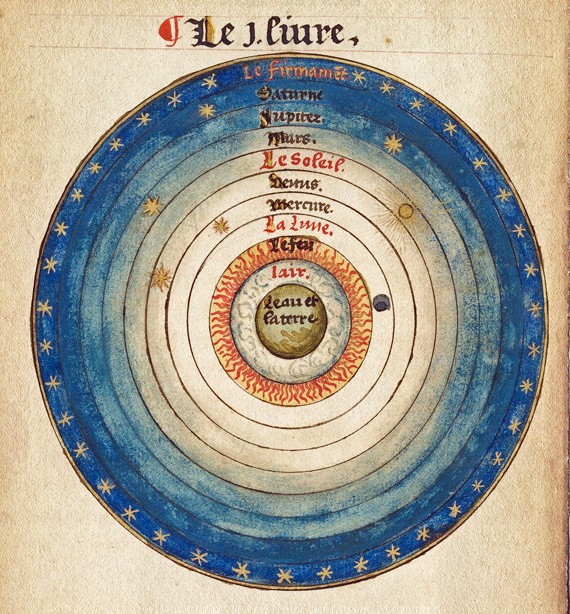
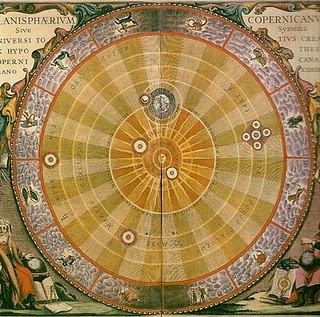
    This idea was further expounded on when looking at the model of the universe according the Aristotle/ Ptolemy that puts the earth at its center, divided into the four level of the element (Fire, Air, Water and Earth) and surrounded by the seven planetary spheres, the sphere of the fixed stars and finally the Primus mobile, beyond which exists the single pure source, the one, the monad that put the whole scheme into motion5.

    The further out we move from earth, the more constant, less corrupted, and purer a thing is considered to be. The zodiac exists in the furthest sphere from earth. It is closest to the Source from which it was conceived. The symbolic nature of the zodiac inspires us to reach for the heavens and search for meaning. 

    As we move towards Earth through the planetary spheres, the more distant a planet is the more stable its cycle. The superior planets: Saturn, Jupiter and Mars which are furthest from Earth6 have a relatively constant cycles; but once we get to the inferior planets: Venus and especially Mercury their cycles get far more complex, their movement more erratic and harder to follow. The Moon, moving swiftly connects the planets and distributes their virtues to the central sphere that is the Earth. This central sphere, our manifested world, is forever changing: the cycle of birth, growth, decay, and death is inherent through the continual interaction of the elements and their primary qualities7.

    The astrological houses are measured from the perspective of a particular place on earth. They are a division of the sky that is measured from the ASC, the eastern point of the ecliptic, a ‘fixed’ point relative to a particular place on earth and the MC the highest point on the ecliptic. The houses map the primary motion of the Sun/ Moon and other planet’s daily journey through our skies. The relationship of the houses with the observer is altogether more personal and direct, and through them the effect of a planet in the zodiac is grounded to reveal its specific influence upon a particular place on earth at a particular moment in time. From the perspective of the Ptolemaic/Aristotelean cosmos, the doctrine of astrological houses is by definition the most ‘corrupted’ and least pure thing in our astrology. The houses are earth bound, they are created relative to a particular place on this planet; they are at once forever changing and simultaneously fixed to a place/point in the manifested world we experience.8

    Houses evolved to represent areas of life and arenas of earthly, human experience. Houses reveal the stage on which the drama of human experience unfolds, and if we are being honest, we have to admit that we love a good drama.

    Is it a wonder that house systems are the one area of astrology that people become attached to or in some cases reject outright, as in the case of Cosmobiology. Is it a wonder that it also the most disputed? Is it a wonder that the subject of houses causes some of the most dramatic and emotive arguments between otherwise level headed astrologers? I think not.

    Choose your house system (or not), continue working with the higher beings that populate our cosmos, commit yourself to mastery, take responsibility for your words, be present and humble, but most of all, always remember that opinion is not knowledge.


    1. For a more thorough understanding of this see Martin Gansten’s paper on the subject https://brill.com/view/journals/ijdp/4/1/article-p1_1.xml
      ↩︎
    2. For a full breakdown of the differences in house system see Deborah Houlding’s The Houses: Temples of the Sky (The Wessex  Astrologer Ltd 2006) ↩︎
    3. Corruption is related to the constant change of physical corporal life. All life on earth eventually dies and decays. This is the meaning of being impure and corruptible. ↩︎
    4. [1] The fascinating fact that Mercury is the planet that signifies astrology and is associated with the rational mind should not be lost to any of us. Its glyph incorporates: the cross of matter, the circle of spirit and the crescent of soul. ↩︎
    5. Some model added an extra 10th sphere between the fixed stars and the Primus mobile…that of the Zodiac. I would ascertain that this would be when the Zodiac became connected with the cardinal seasonal points and decoupled from the stars. ↩︎
    6. In the Aristotelian/Ptolemaic scheme of the Universe ↩︎
    7. The two active qualities: hot & cold initiate movement. The two passive qualities: moist & dry modify it, creating the elements and constant cycle of life. ↩︎
    8. The ASC/DES and MC/IC anchor is fixed to a place on earth and will remain the same relative to that place, regardless of time or season. (If 21 Leo rises and the MC degree is 14 Taurus; every time 21 Leo rises at that place, 14 Taurus will be the degree on the MC.) ↩︎

  • Using traditional techniques is it possible to find “evil” in the natal chart?


    EVIL  • adjective 1 deeply immoral and malevolent. 2 embodying or associated with the devil. 3 extremely unpleasant: an evil smell.  • noun 1 extreme wickedness and depravity, especially when regarded as a supernatural force. 2 something harmful or undesirable.
    In religion and ethics, evil refers to the “bad” aspects of the behaviour and reasoning of human being – those which are deliberately void of conscience, and show a wanton desire for destruction. The opposite of goodness, which itself refers to aspects which are life-affirming, peaceful, and constructive.


    Can evil be seen in a chart? Do certain individuals choose to be evil or are they fated to be so? And do their charts reflect this? And are we fated to live out what is in our chart? These questions are all loaded and profoundly disturb many in our profession. 

    In this day, when even the ancient descriptions of planets as benefic and malefic elicits discomfort in contemporary astrologers, it is no longer regarded as correct to think in these terms.  The idea that a planet or person could be inherently bad goes against our accepted standard of judgment. Deviation from acceptable behaviour is seen as an understandable reaction to the emotional and psychological experiences that have traumatized or otherwise wounded individuals.

    Ironically as we move away from judging an individual as evil we continue to embrace the idea that evil exists in the world. As illustrated by our “war on terror” and our fear of the “terrorist threat”. The concept of evil has always been present but we have confused the doing of evil with being evil.

    When our ancestors spoke of a planet bestowing malevolent or benefic influence in a horoscope, we tend to imagine this as being a very cut and dry affair: bad planet cause bad things, good planet, cause good thing. The reality is far richer and more subtle than it appears at first glance.


    The Malefic Planets: Mars & Saturn


    In the traditional cosmos the so-called malevolent planets were Mars and Saturn. At their best both are a necessary and positive force in the chart, allowing us to take righteous action, be responsible and build strong foundations. Both have ‘jobs’ related to ending and death. When these planets were afflicted, they went out of balance and their influence becomes negative and destructive.

    A planet is at its best when in essential dignity and with some reception. A debilitated planet has a really hard time expressing its true nature; they become an exaggerated or distorted version of themselves. Mars doesn’t just take action; he kills all who stand in his way. Saturn doesn’t just take responsibility he becomes tyrannical. The other planets can also cause trouble when in a debilitated condition, but their effect is unlikely to be thought of as evil.

    Whether fate is pre-destined or created by the native’s choices is a tricky one.  The modern paradigm places more emphasis on the free will and choice of the individual then was the case in the past. In previous generations the individual had their place within the social hierarchy and few had any choice about it. Even those at the top of this hierarchy had limited choices. Overseeing all, there was God.

    Now we may speak of the higher self rather than God. Many have become uncomfortable with the concept of a Supreme Being overseeing us all, choosing for us, and allocating our fate. The concept of the “higher self” individualises us, if not in fact certainly in title. It allows us the illusion of having more power to choose. Regardless of our modern belief in the importance of the individual, fate can not be denied; it is what is bestowed on us.

    We are born into a certain era or time, a particular body, gender, to a particular set of parents, within a family, culture and nation. We do not consciously choose this; we are given this. This is fate. Our free will to choose is confined to limits of our given fate. Man’s essential nature is both corporeal and spiritual; the integration of these polarities draws us closer to our essential nature. Essential nature by definition signifies a more balanced state of being.  A state more aligned with the Divine, however we define that word.

    In nature a daisy will grow into the best daisy specimen possible within the environment it is given. It can not do otherwise or choose to grow into a rose. Because nothing in the natural world can stray from its essential nature, there is no evil there. A volcano may cause devastation, cruel as this may seem, it is nothing more then the restoration of balance. Nature has no will to choose otherwise. But the human being has free will to choose and can turn away from his essential nature. He must come to know and accept who he is, what he has been given, understand his purpose in the scheme of things and fulfil it.  The further away from his essential nature he moves the more he encounters evil or in the words of our fore bearers; malevolence.

    The principal thing that pushes man away from his essential good nature is his desires; desire that stem from his corporeal existence. His desire to possess more than what he has been given, to have more power than he needs and to strive for a purpose not of his own.  In modern jargon these corresponds to the ego and remember that the ego is never satisfied.


    The Lord of the Ascendant, Pilot of the Soul and
    The Significator of the Quality of the Mind


    Using traditional astrological methods, we can see in the natal chart how easy or not it will be for an individual to stay aligned with his true nature and how strong the pull of his desires will be. By identifying three planets: the Lord of the Ascendant, the Pilot of the Soul and the significator of the Quality of the Mind, we have the information needed to judge how likely one is to move towards or away from his/her essential nature.


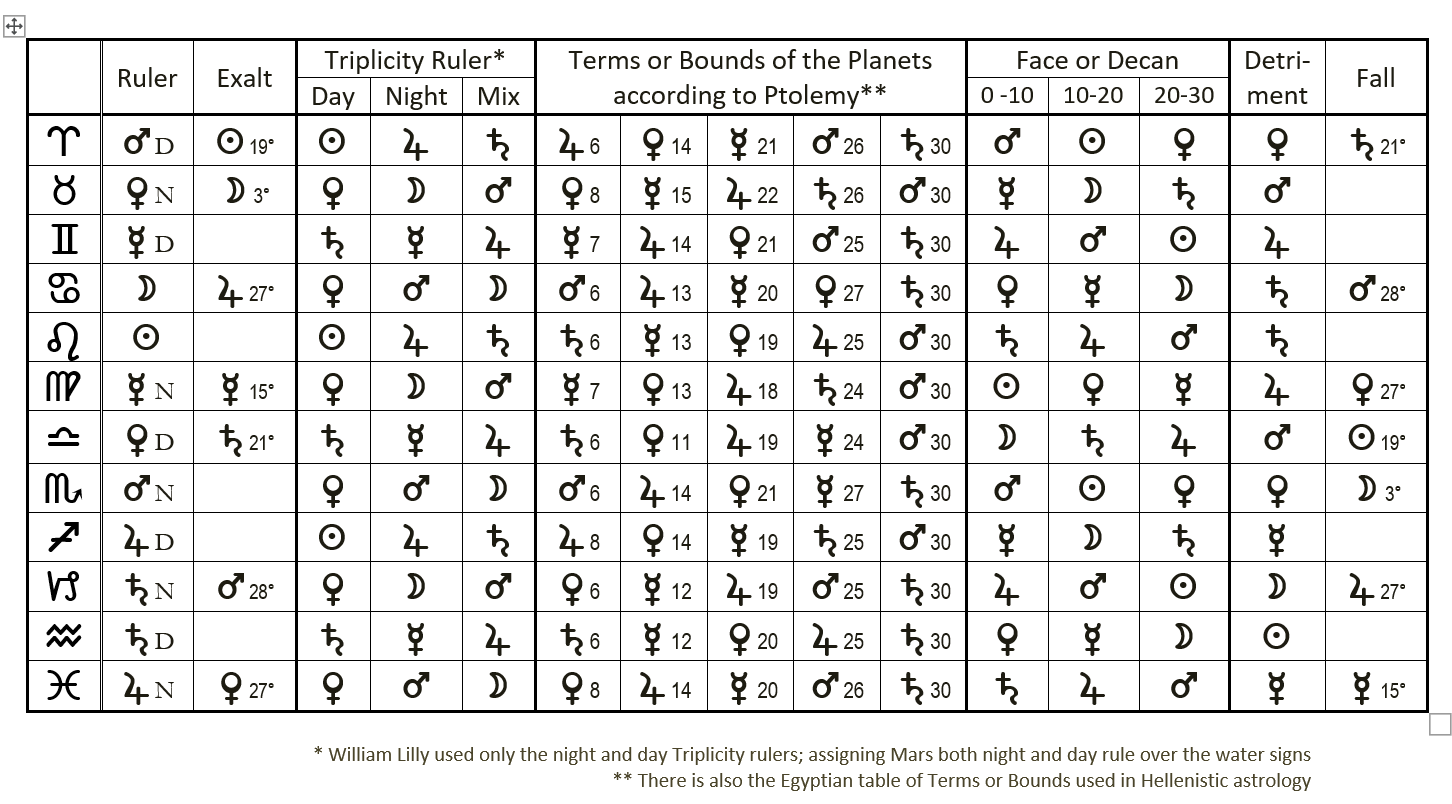
    To find these planets we use the table of essential dignities to calculate the almuten (overall ruler) of particular degree of the zodiac. Giving the planet in rulership 5 points, in exaltation 4 points, in triplicity 3 points, in term 2 points and in face 1 point, we simply add up the points for each planet to find the one with the most essential dignity at a particular degree or degrees. It is important to note whether it is a day or night chart and use the appropriate triplicity ruler.

    The Lord of the Ascendant is the planet which has the most essential dignity at the ASC degree, in other words the almuten of the ASC. Often this is the planet ruling the ASC but not always. As the overall ruler of our ASC this planet is most concerned with our corporeal life; the driving force that motivates us. In modern jargon we could say it signifies our ego.

    The Pilot of the Soul, is the planet with the most essential dignity overall; and in the strongest position, in the chart.  Ideally it would also be free of accidental debility such as retrograde or combustion. The Pilot of the Soul is the planet that would ideally take charge. This is the planet that could set us on the right path and redirect us if we get side-tracked. This is the planet most closely aligned to spirit; most connected to Divine source. This is the planet we should endeavour to engage and make friends with, for it is most likely to raise us above our corporeal fate.

    Finally, we find the significator of the Quality of the Mind by finding the compound almuten; the planet with the most essential dignity at the degrees of the Moon, Mercury and ASC.  Quality of the mind does not refer to intelligence, but rather to how and to what purpose the mind is used. It relates to conscience and the moral nature of the native. This planet represents the balance between their sensible and rational minds and how well their corporeal and spiritual facets integrate. In other words, do they use their mind for good or evil?

  • Traditional and Modern astrology: a philosophical exploration (part 5 – Pythagoras)


    Pythagoras and the Magic of Numbers


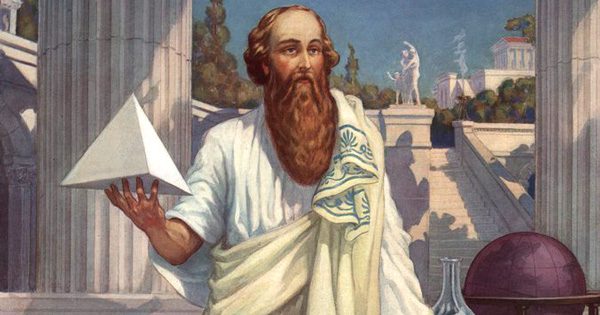
    It is probably redundant to say that most everything in our Universe can be understood through numbers. Mathematics is truly the universal language, the secrets of which were first explored and brought to our consciousness by Pythagoras who lived from about 570 to 495 BCE. He was a philosopher, mathematician, mystic and scientist who established a philosophical school in Croton in Southern Italy. Plato was one of his students. Little is actually known about Pythagoras the man; however his ideas and teachings have been very influential. Pythagoras is famous for saying that “ALL is number”. While we may never know whether Pythagoras the man actually said this, we do know that he saw numbers as more than just a means of quantifying things; to the Pythagorians numbers were understood to have and to bestow qualities as well.

    The ideas attributed to Pythagoras gave rise to sacred geometry as well as musical theory. His assertion that numbers had qualities and could be experienced expanded the notion we have of mathematics to include an esoteric dimension which included the ability to bring about healing. The doctrine of aspects in traditional astrology is based on Pythagorean principles.


    Pythagorean number theory


    One or the Monad is not considered a true number; it is the principle of number. It signifies the creative potentiality of all things, for it is potentially any number. It is both mother and father and is the source of all other numbers. One, is like God for it preserved; multiplying by one always gives you the number you started with, it preserves that number. It is unity that has yet to be manifested as it remains potentially anything and everything.

    Two or the Dyad is also not considered a true number; but rather a process that flows from the Monad. Two is the source of multiplicity and the principle of knowledge, for it creates the difference between the knower and the known. The Dyad is said to attract the Monad to it and from it generates the rest of the numbers; as such it is related to love.

    Three is the first actual number. It is a figural number because three points creates the shape or figure of a triangle. Three signifies knowledge and consciousness, as the knower and the known can now be recognized from a third perspective, bringing about conscious understanding or consciousness of knowing. The trine is related to three, giving easy understanding or communication between the planets.

    Four is the number that represents manifestation and solid physical foundation. It is of course related to the square. The circle, which has no beginning and no end is said to represent unity or God as yet not manifested, the square represents manifested unity. From an astrological perspective four can be associated with the foundational cardinal point of the chart; the angles ASC, IC, DES and MC. These represent the body/health, home/family, relationship/marriage and career/purpose which are the foundation of human life.

    The multiplication of three and four gives us the number 12 and we have twelve zodiac sign. While the addition of three plus four gives us seven which corresponds to the seven visible planets.

    Six is a perfect number for it contains one, two and three (1+2+3=6), it is both odd and even (2×3=6). It is the number associated with reconciliation and represents “ensoulment” of the body by the soul. The number six creates 2 triangle that fit together bringing the elements together or God and the manifested world together.

    We can see evidence of the Pythagorean number theory is the traditional doctrine of aspect. The monad is like the conjunction, the Dyad is like the opposition, the number three relates to the trine, the number four represents the square and finally the number six relates to the sextile.

    Twelve was seen as representing a version of the bodies/sphere in the Universe: the one eternal and unifying God (realm of the fixed stars), the 7 planets, the 4 sub-lunar elements(fire, air, water and earth), arranged from most orderly to the least, from most perfect to most corrupted.


    According to the Pythagorean understanding there were 3 parts of the Soul: the Curious part, that seeks knowledge, the Ambitious part that seeks honours and the Covetous part that seeks profit or power. Each part of the soul needs to function properly and be harmonized with the other 2 parts. We can associate these parts of the soul with the 3 traditional outer planets; the Curious soul with Jupiter, the Ambitious soul with Mars and the Covetous soul with Saturn (as the empire builder).

  • Traditional and modern astrology: a philosophical exploration (part 4)


    How does Greek Philosophy Relate to Astrology?


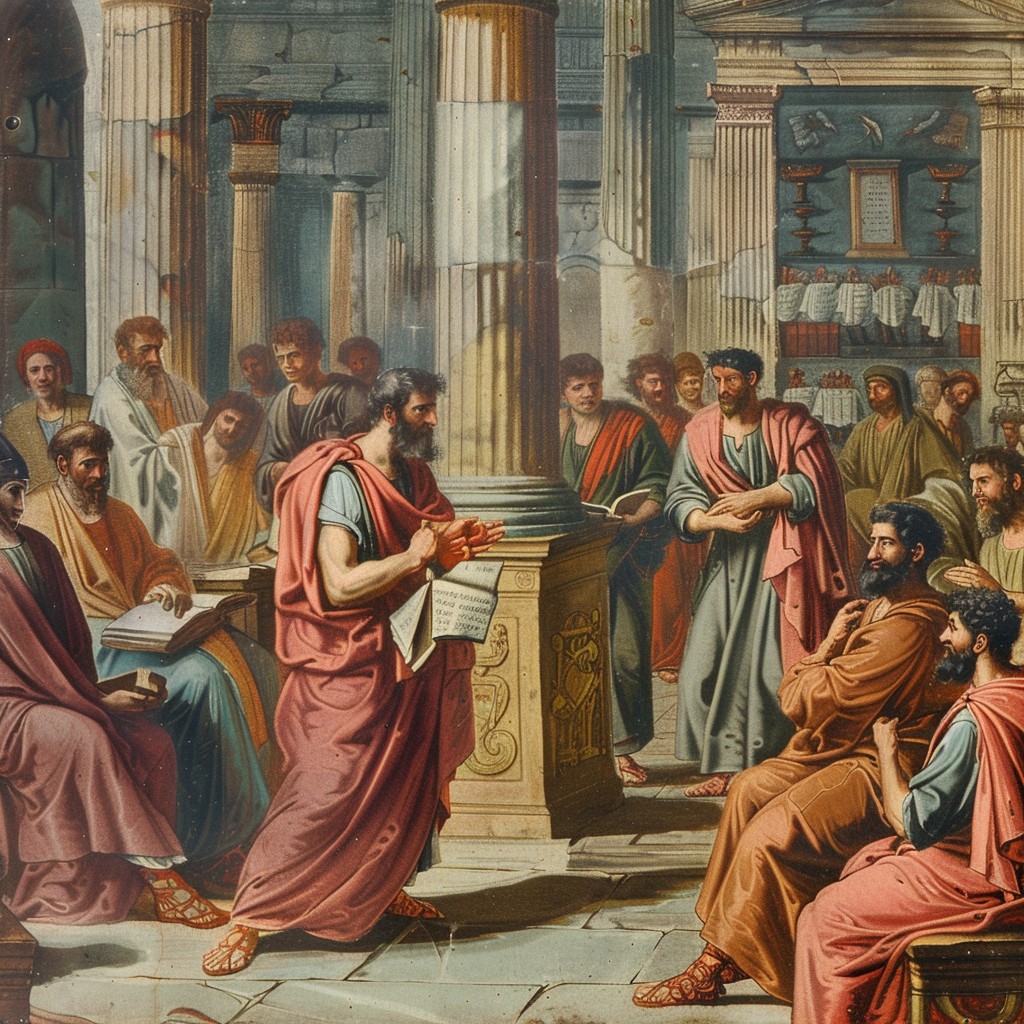
    Horoscopic astrology developed alongside the ideas of classical Greek philosophy. It could be said that the observation of the sky and planetary motions inspired much philosophical musing. In the past there was little separation between science and philosophy, between religion and astrology or between mathematics and magic. The world was understood to be idealistic; that is that idea or mind came before matter, matter being a result of idea.

    From this perspective spirit and matter were considered equally real and important. The interplay and mutual relationship between God and humans or the planets and the affairs of the earthly realm was a given. The axiom “as above so below” rang true in every sense of the words; what occurred here on Earth was naturally to be reflected in the movement of the cosmos. This was not perceived as magical, but rather as logical.

    It is only when our focus began to shift from a spiritual perspective of life to a biological one that matter became the ultimate reality and soul a construct of the human mind. This shift had a profound effect on our world. Mechanical science and technology has changed life on this planet as well as our human consciousness. No longer are we part of a tribe, no longer do we accept the concept of a predetermined fate, no longer do we see the movement of the planet and stars as evidence of their soul or ours, and no longer do we accept magic as being natural. For the most part we now see ourselves as a collection of individuals jostling to be and to find our purpose; our bodies and the rest of the material world is a manifest proof of chemical reactions that adhere to the laws that govern the physical universe. We elevate logical and rational thought based on sensible evidence over and above magical thinking that is dismissed as flights of the imagination, not based in rational reality.

    Astrology has reflected this change by becoming primarily focused on the individual and his inner processes of realization. The natal chart has been elevated to being a tool to help in the individuation of the native. Astrology’s recent focus on the psychology of the individual is an illustration of this shift.


    The Roots of Traditional Astrology


    To really understand traditional astrology we need to shift our focus from the modern paradigm and reset it on how the world and cosmos were understood around 2500 years ago, when horoscopic astrology first began to appear. One of the first problems we encounter is the modern notion of evolution and progress, which has ingrained itself so firmly into our psyche that it is difficult for us to accept that where we find ourselves is anything but a higher more evolved level than what came before. We need to perceive the past not through the prism of the present, nor through the romantic notion of a past golden age, but rather from the neutral position of a novice or student eager to learn.

    We need to let go of our preconceived ideas about astrology and accept that there is much we can learn from the ancients. This can be a very uncomfortable process as cherished notions and ideas need to be relinquished or at least re-examined. At the same time, it is immensely freeing to open our minds to other possibilities. Our understanding of concepts such as: god, soul, evolution, knowledge and information are different to what they were in the past and it is important to appreciate these differences.

    Much of the rational for astrology can be found in the philosophical ideas and principles of ancient Greek philosophers including Pythagoras, Plato and Aristotle as well as the Stoic school. Having even a cursory understanding of these can be immensely informing to the astrologer.

    part 5

  • Traditional and Modern astrology: a philosophical exploration (part 3 – the birth of modern astrology)


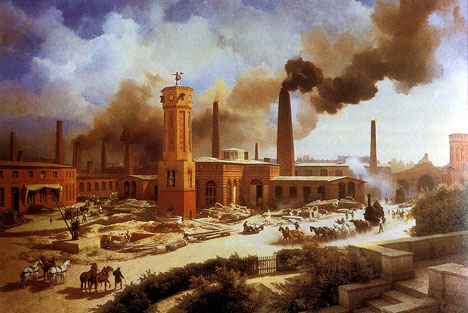
    The industrial revolution (1750 – 1850) changed the lives of ordinary people and had a profound effect on society. The shift from an agriculturally based economy to a manufacturing one saw a decline in rural population and an increase in urban living. It also led to changes in the distribution of wealth and class distinction; as entrepreneurs were able to make fortunes in manufacturing which in turn created new jobs and led to the rise of a new middle class through the 18th and 19th century. As this middle class became more numerous, better educated and influential, they developed an interest in and fascination for occult subjects and mysticism evidenced by the founding in the mid- 19th century of the theosophical society amongst others. It was through the mystery schools of the late 19th early 20th century that astrology began to re-emerge from its years in the wilderness and find a new audience.

    The astrology that returned was changed and coupled with the legal challenges that many of its practitioners faced, astrology came to reject event-oriented and predictive horoscopic analysis while focusing on natal astrology with an emphasis on character analysis and the psychological and spiritual development of the individual.

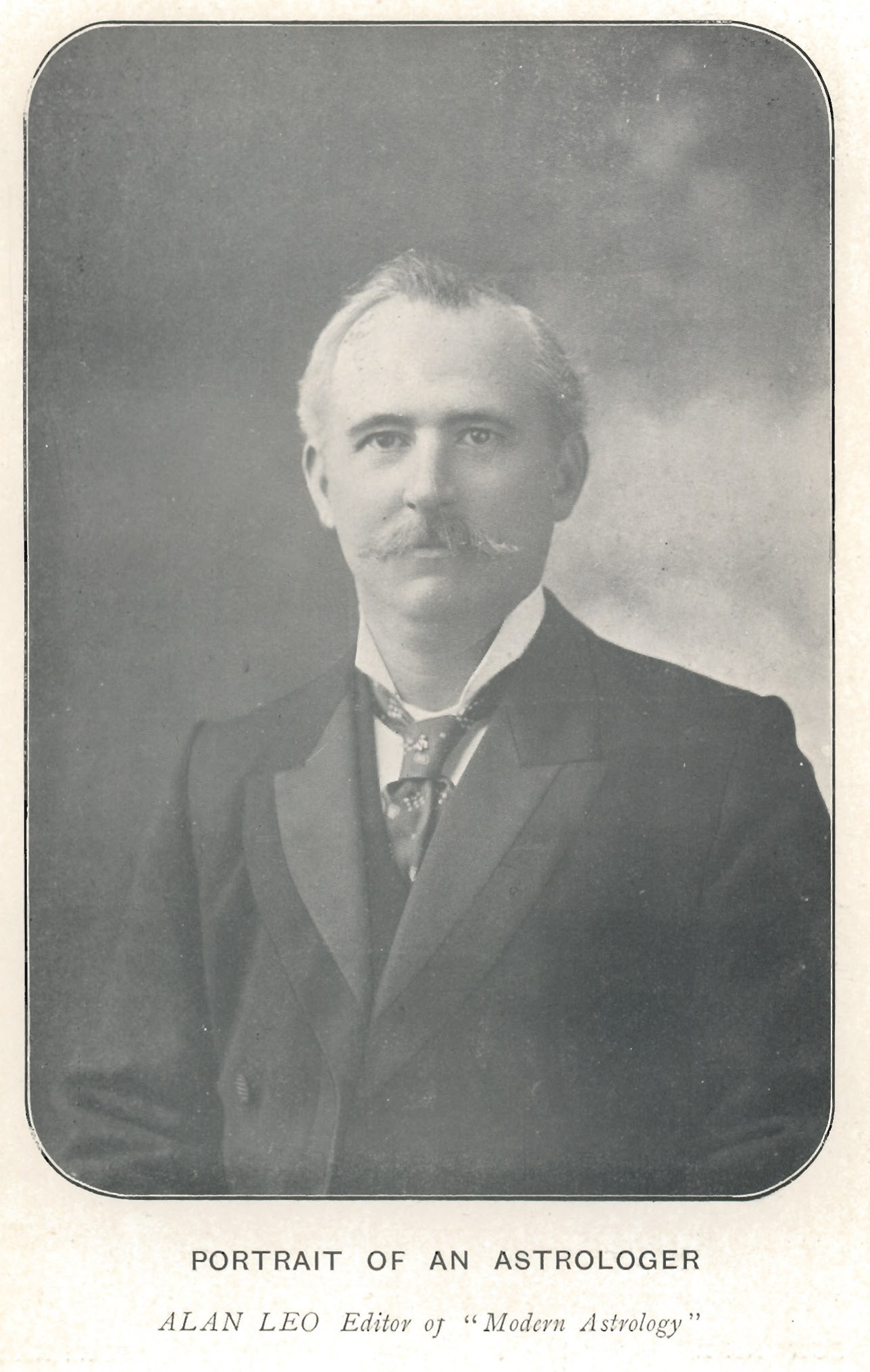
    It was Alan Leo (1860 – 1917), an immensely successful and influential astrologer who through his work put astrology firmly on the road to the more individual focus and psychologically-oriented horoscope delineation of modern times. He is rightly known as “the father of modern astrology”.  Being a devout theosophist he also incorporated many of the concepts of karma and reincarnation into astrology. One of the principle things that modern astrology rejected outright was horary, which was seen by Alan Leo as being spiritually dangerous.


    “Horary astrology, as practiced today, is the vilest rubbish imaginable, and not worthy of the name. Indeed, it is not astrology at all, but simply divination, for which purpose geomancy or card laying would answer just as well… It is the curse of the science and the ruin of the astrologer.”1


    While it could be argued that so much of the techniques and knowledge of traditional astrology had been lost, making the practice of horary near impossible, the main issue was probably more philosophical and possibly legal.

    By the early 20th century the world had changed to such a point that the reasons for astrology’s initial decline were but a distant memory; a forgotten and irrelevant footnote in the history of science. It had been so long since astrology had figured in serious theological, intellectual or scientific discussion, that most would find it unlikely that it ever had.

    Without prediction, astrology was safe from legal persecution and accusations of fortune telling. Focusing on character analysis was a good way of deflecting any awkward need to justify astrology to an intellectual world steeped in a scientific perspective, which was firmly focused on material rationalism. Astrology could continue to amuse and entertain the masses without being any threat to serious thinkers of the day.

    The astrology that emerged in the early 20th century was rooted in the mystery schools of the 19th century. It was also informed by the new science of psychology and the advances in astronomy. This astrology incorporated recently discovered planets, emphasized universal significance of the signs and planets and became firmly focused on natal astrology and character analysis. By the 1980’s ancient myths, Jungian ideas, popular psychology and a sprinkling of “new-age” concepts were dominating astrological discourse, but astrology was still unacceptable in serious, academic circles.


    1. Alan Leo from Modern Astrology II/VII: 10 (1896) pp. 434-437 as quoted by Patrick Curry in A Confusion of Prophets Collin & Brown (1992) p. 165 ↩︎
  • Traditional and Modern astrology: a philosophical exploration (part 2 – history)


    While we may never know exactly how or when horoscopic astrology first began. We do know that it sprung out of a time and place that was greatly influenced by the cosmological ideas of the Babylonian, the celestial religions of the Egyptians, the Hermetic magical understanding of correspondence in nature and the philosophies of the great classical thinkers and their schools, including Pythagoras, Plato, Aristotle and the Stoics. The period between the 4th and 2nd centuries BCE was a time when many of the ancient cultures and their accumulated wisdom came together. The city of Alexandria and its famous library became the cultural and commercial centre of the Western world. Here Jewish, Egyptian, Babylonian and Greek traditions intermingled and unified under the Greek language of the Hellenistic lords. Horoscopic astrology appears to have been the results of this interchange of wisdom and ancient learning.

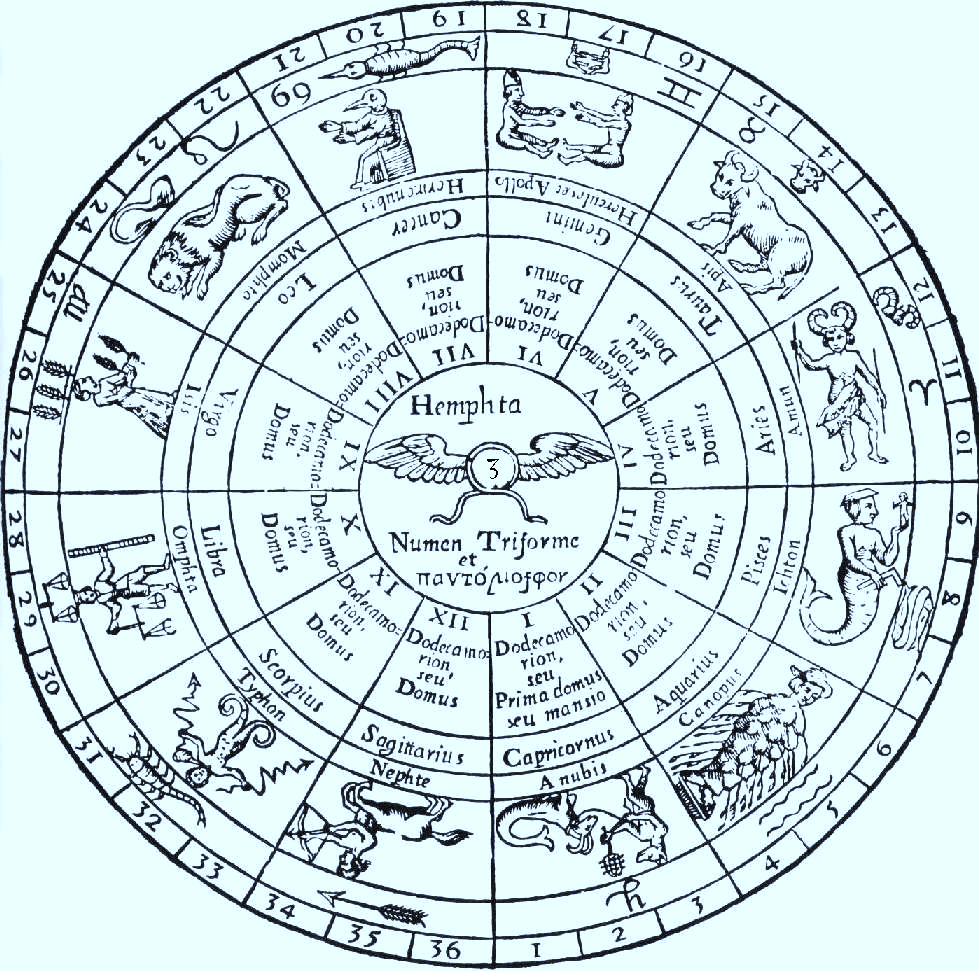
    The Babylonian contributed their concept of the 12 fold zodiac and the planetary positions in the signs. The Egyptians brought the concept of the 36 decans and the importance of the rising decan which is possibly the origin of the Ascendant and it’s the importance in the horoscope. The Greeks contributed their understanding of the characteristic of the planetary Gods, the elements and most importantly their system of planetary rulership which was based on the distance of planets to the Sun.1

    From these rich ingredients arose horoscopic astrology; a subject which was to profoundly influence man throughout his cultural, religious and political history. Astrology was understood to be at various times: a tool for predicting a predestined and fated future, a way of interpreting the will of God or the Gods, a form of Divination with which one could enter into a dialogue with the God(s) and sometimes a bit of all the above. By highlighting some of the mysteries that have fascinated mankind since the dawn of the ages, astrology engendered serious philosophical and scientific debate and challenged intellectual thought and beliefs over the centuries.


    Horoscopic Astrology


    One of the foundations on which horoscopic astrology was based was a perception of life which was accepted for over two thousand years. This view was idealistic and held that the physical, transient, sub-lunar world that we experience through our senses was the result or expression of an immaterial, eternal and essentially divine reality. Over the centuries the details of what that essential reality actually constituted and how the natural world and humans were connected or related with it, was the subject of much debate; however the understanding that matter was subservient to a higher and more refined spirit or mind was the accepted paradigm.

    In the centuries leading up to the birth of the Jesus, the pagan religions perceived the world as being at the mercy of the Gods whims. The planets were representatives or symbols of these Gods, and so could be relied upon to display their will or intentions. Astrology could forewarn man of the Gods intentions; man could then proceed to make decisions that were in accordance with them, thereby avoiding the displeasure and wrath of their Deities.

    In the early centuries CE, as pagan polytheist beliefs were overshadowed by the monotheist beliefs of the Judaic/Christian and later Islamic religions; the planets lost their positions as representatives of myriad Gods, but retained their role as emissaries or signs from the singular Divinity, at least for a period of time.

    As Christians challenged the dominance of pagan beliefs in the 3rd and 4th centuries CE, the role and influence of astrology changed. Astrology reached a height of sorts, during the dying days of the Roman Empire. The Roman emperors used astrology as a tool to give them political advantage; though this was not always to the advantage of their astrologers2.

    With the collapse of the Western Roman Empire, schools and libraries closed as financial support dried up, the knowledge of the Greek language died out, and the people became less literate. It is with gratitude that we should view the Arabic and Persian astrologers of the early Middle Ages; for while Europe descended into the period we now know as “the dark ages”, the intellectual light was transferred to the Middle East and there the wisdom of the ancient world including astrology was preserved, refined and expanded.


    Astrology in the Arabic World


    In the 5th and 6th centuries Hellenistic astrology travelled to the East and was intermixed with the astrology of the Persians3. Many of the Greek astrological texts were translated into Pahlavi (the language of the Persians) and we can surmise that some additions would have been made. It is unfortunate that no manuscripts from this period have survived, having been destroyed when later the Arabic Muslim armies overthrew the Persians and established their own empire.

    Finding themselves in need of help to administer their empire the Arabs invited experts and intellectual giants of the world to assist them in building and maintaining their empire. They established a cultural, commercial and intellectual center emanating from their capital Baghdad; a city whose foundation date and time was elected by a group of astrologers4. For the next few centuries Baghdad and the Arab world attracted philosophers, artist and intellectuals of all sorts including astrologers.

    Medieval or Arabic astrology flourished from the mid-8th century and lasted for about 200 years. A new translation project began as surviving Greek and Pahlavi texts were translated into Arabic. While the so called Arabic astrologers of the 8th and 9th centuries (many of whom were actually either Persian or Jewish), did refine some technical and mathematical points, the astrology they practiced remained for the most part, Hellenistic. It is from this period that we begin to encounter the concept of planetary orbs, quadrant house systems and the beginning of horary astrology proper.

    By the 11th century Europe began to reawaken from its 600-year hiatus. As the Christians began to repulse the Muslim from the Hibernian peninsula and reclaim their territory; they discovered the libraries left in their wake. Europe’s intellectual fire was reignited. By the mid-12th century one of the most feverish translation projects began. Arabic texts on all subjects including many on astrology were being translated into Latin. Classical Hellenistic works were made available for the first time in over six centuries to a very intellectually hungry Europe.


    Return of Astrology into Europe


    After astrology was reintroduced into Europe in the 12th century, it took its place at the centre of theological, scientific, mathematical and philosophical debate. It was an accepted subject of serious study that invited much debate, criticism and controversy5. It was one of the principle subjects taught in the newly founded Universities. The basic curriculum consisting of the foundational trivium: grammar, logic and rhetoric; and the more advance quadivium: geometry, music, astronomy and arithmetic.

    It is important to remember that during the middle age and renaissance, science and theology were more closely aligned; in fact, religious dogma aside, they had the same goal, to understand and come to know the nature of life and the universe. Within the study of nature, God was a given and needed to be reconciled with science as well as astrology.

    In the west astrology reached the apex of its popularity and influence around the mid 1600’s; a time in which the political and social structures of Europe were irreparably changed by the English civil war, which culminated in the execution of Charles I.6 At the end of the 17th century astrology experienced a sharp decline in influence. The reasons for this decline are multi-faceted and complex.7 Astrology did not die so much as it was split into various factions that were unable to survive the tumultuous paradigm shift of the time.


    The Splintering of Astrology


    After the restoration (circa 1660 – 1685) there was a backlash against astrology, more specifically judicial astrology8, which had been used as a propaganda tool during the volatile and insecure period of the civil war. Astrology had become associated with seditious radicalism which was perceived to be the cause of so much destruction and unrest. The natural desire for calm and peace made many suspicious of anything that reminded them of that dangerous and dark period in their recent history; therefore astrology and astrologers were no longer trusted.

    At the same time the new intellectual climate favouring a more Baconian9 science based on observation and experiment, began to view judicial astrology as being irrational and overly steeped in magical thought and superstition. Publicly astrology lost favour with the intellectual world. Though many of the great minds of the late 17th, early 18th century privately acknowledged the validity of astrology, especially natural astrology10, they believed that judicial astrology had been corrupted and needed to be purged of irrational beliefs, popular magical connotations and political rhetoric. Many hoped to restore astrology, bringing it more in line with “natural philosophy”.11

    There was another branch of thinking which believed that astrology had strayed from the purity of its classic Ptolemaic roots, and needed to be purified by eliminating the ‘false Arabic inventions’, the magical thinking and the new rational scientific thinking that had polluted astrology. Though many wanted astrology to be restored or purified in order to takes its rightful place in the world of the educated elite, its negative reputation and fragmentation weakened it so that it could not defend itself against its critics.

    As the world and life came to be understood from the perspective of mechanical, material and intellectual rationale, rather than from the perspective of divine creation and immaterial soul; the perceived connection of astrology to divination and magic led to its diminishing importance in science and philosophy, and its eventual banishment from intellectual discourse. By the early-18th century much of what had previously been the domain of astrology, became redefined as astronomy or medicine; while astrology was dismissed as trivial and irrelevant or worse, misguided superstition. By the end of that century astrology had been relegated to the fringes and was of no consequence in academic or intellectual circles.

    A third arm of astrology did survive and remained popular with the majority of the rural and uneducated public; this was the simplified astrology of the popular almanacs which the intellectual elite rejected and mocked as being only fit for the “vulgar” commoners. The common rural folks held on to evident truth of idealism (mind before matter) for longer.

    Eventually even this more popular astrology was attacked when the vested interest of the industrial power fought to eliminate these almanacs because they were rooted to a past that was subject to the natural rhythms of time, which did not accord with the more mechanical “clock” time of the industrial age.


    1. For a full and detailed history of astrology’s beginnings see Nicholas Campion, the Dawn of Astrology, (Continuum Books, the Tower Building, 11 York Road, London) ↩︎
    2. See Ben Bobrick, The Fated Sky: Astrology in History (Simon & Schuster, Rockefeller Center,  New York)p. 27-60 ↩︎
    3. Sassanian Persian empire flourished between 220 to 650 CE ↩︎
    4. The chart was elected by the Caliph Al-Mansur’s court astrologer Nawbakht the Persian, Umar al-Tabire and the young Masha’Allah. The chart was set for July 31, 762 around 2:40 PM in Bagdad, Iraq. ↩︎
    5. Benson Bobrick, The Fated Sky: Astrology in History, (Simon & Schuster, Rockefeller Center, New York) p. 91-92 ↩︎
    6. The execution of the King was a momentous event which destroyed the long held notion of the “divine right” of the King to rule.  I believe this created a split between us and the divine, which has led to the fragmentation of our world. ↩︎
    7. For more information about this see Patrick Curry, Prophecy and Power (Princeton University Press, Princeton, New Jersey  1989) ↩︎
    8. Judicial astrology refers to specific chart analysis and judgment leading to individual prediction or advice, as different from natural astrology which looks at the natural phenomenon such as weather, health and mundane events, associated with celestial movement and cycles. ↩︎
    9. Roger Bacon (1214-1294) whose ideas were later developed by Francis ↩︎
    10. See note 6. ↩︎
    11. Natural sciences ↩︎
  • Traditional and Modern Astrology: a philosophical exploration (part 1)


    Once we enter the world of traditional astrology our view of life and the world changes. It is very difficult not to be influenced by the great astrologers that came before us. However, it is the incredible commonality between human experience of the past and our own that takes us by surprise. We live in a world that is imbued with the ideas that promote evolution and progress. Whilst everything on earth is born, grows, withers and dies in the endless cycle of life and death giving rise to the illusion of a forward movement of time, it is but that; an illusion.

    Traditional astrology understands the importance of Saturn, not only as the ally of the astrologer but also as the significator of time. Saturn of old was also called the Lord of deception and it is possibly his rulership over time which earned him this moniker. As astrologers, we deal in time and are prone to get caught in its apparent but deceptive forward momentum. But looking back into the past, we recognize that we have not moved far. The cycles of life, of the planets and stars, mark our experiences, but time stands still in a forever present moment that is re-experienced over and over and over.

    The theory that Darwin made famous; that every living creature adapts and evolves is so accepted that it is nigh near impossible to conceive of a past that is not somehow more backwards than our present day. Astrologers are far from immune to this notion and so they take up each “new” discovery in our skies as a sign that we, the collective, have evolved in our consciousness. This implies that in the past, the consciousness of the people was not as evolved and therefore was lower than that of people alive today.

    Even a cursory knowledge of political, philosophical or even astrological history would disprove this notion. The wisdom of the past is awe inspiring when one makes friends with Saturn and takes the time and effort to explore it.


    Traditional and Modern Astrology


    The word traditional means to follow a tradition, which is defined as: “a) Passing of beliefs or customs from one generation to the next. b) Any long held method, practice…etc.…” 1 All forms of astrology practiced today fall into the definition of tradition, as all derive from the ideas and work of others who have come before.  The term “traditional astrology” has over the past 20 years or so, come to mean the astrology as it was practiced prior to the late 17th century, but this is not to say that modern astrology does not have its own tradition. However it is important to remember that there was a major break in the transmission of astrological knowledge which has resulted in the development of a very different type of astrology in the 20th century; this is the astrology we call modern.

    Many modern ideas that have been incorporated into astrology are recent additions to a very ancient subject that have little connection to its past tradition. With the recent availability of modern translations of the older texts, we are experiencing a resurgence of interest in traditional astrology, which has reinvigorated the field but also highlighted some divisions within the rarefied world of astrology today.

    Horoscopic astrology as it was practiced prior to 1700 encompasses roughly 2000 years of tradition2: and it includes the astrology as practiced by Vettius Valens, Ptolemy, Masha’Allah, Guido Bonatti through to William Lilly and his contemporaries. Over this time astrology was refined; certain techniques were developed, the application and emphasis on astrological doctrines shifted and changed to reflect the cultural, philosophical, religious and political developments of the times and location.

    There are differences between the astrology that William Lilly practiced and that of Vettius Valens, however they are founded on the same basic fundamentals and are more similar than is the astrology of William Lilly to that practiced by the majority of 21st century western astrologers. The historical circumstances that led to this situation is one that needs to be understood if astrologers are to reconcile the rich legacy they have inherited to the art that they practice today.

    Part 2


    1. Oxford Advanced Learner’s Dictionary, fourth edition (Oxford University Press, Walton Street, Oxford 1989) ↩︎
    2. There was a long tradition prior to circa 400 BCE of omen based astrology, but astrology that uses a horoscope or chart with a calculated Ascendant did not appear until about 400 BCE ↩︎