Astrology has a problem; it is a perennial issue that most will encounter at some point in their astrological studies, and which can never be fully shaken off. Throughout Western horoscopic astrology’s history this inconvenient problem has caused many a discourse to descent into bitter disagreement and threatened to derail the profound truth and beauty of astrology.
House systems have always been a great point of debate amongst astrologers, sometimes to the point of ridiculousness, as has been made evident by the recent drama unfolding online. The self-aggrandizing and emotionally charged condemnations of those who hold different views regarding the topic; belies the illusion that this may have any real importance in the grander scheme of life, or dare I say, astrology. This is at once sad and laughable.
Over the past few decades, the notion of a whole sign houses (WSH) has become very popular particularly in the US. This has been primarily due to the work of project hindsight, which promoted the notion that the WSH was the original system used by Hellenistic astrologers. The basis of this idea stemmed from their translations of Greek texts, in particular the work of Vettius Valens (75 CE). These texts are actually somewhat vague on which house system was used in practice, and are devoid of any actual drawn charts. Whether the idea of WSH stems directly from any clear statement found in the translated texts, which is debatable; or that it arose from the translator’s interpretation of the texts seen through the lens of their own expectations and preconceived notion on the subject is not the issue that I will be discussing1However, the ensuing controversy is.
While there is still much debate that can be made as to whether this ‘new’ house system is in fact the original system, it is in many regards a moot point. No other area of astrological doctrine has caused so much bickering over the centuries as the division of the sky into astrological houses.
How we choose a house system
Many years ago, I began my formal study of astrology. This was during the height of enthusiasm for humanistic or psychological astrology. As with any astrological course we were introduced to the signs, the planets, and the houses. Charts were presented to us in the preferred format of our teachers. There was no reason or need to question that format, which included the house system of their choice.
Years later when I began to explore works by different astrologers, I started to notice that charts did not always look the same. There was the obvious fact that some astrologer included different points in their chart (asteroids, vertex, Part of fortune); but sometimes the chart looked different because they used a different house system.
At first, I ignored these different house systems continuing to use the one favoured by my original teachers: Placidus. I told myself that it worked, so why go change things. I was not aware of the reason I used Placidus, nor did I know exactly how the Placidus system differed from other house systems, such as Campanus, Regiomontanus, Porphyry, Alcabitius to name a few2. Like many students of astrology, I chose to use a particular house system by default.
As my studies continued, I learned that astrologers have different ways of approaching chart delineation. They had different opinion regarding which technique were best and held differing views on the planets, signs, and aspect. As with any art, the artists choose their tools Astrologers could discuss these differences more often with interest and respect for the other, without resorting to attacks and impassioned demands that their way is the only way and the ultimate truth of the matter. To understand why the subject of houses is so fraught with emotion and passion, I believe it is important to look at the whole of astrology from a larger perspective.
Humans are by nature creative beings. The human experience gave rise to stories and myth which they projected onto their environment. It was only natural that humans would stand in awe and wonder at the Cosmos which enveloped them and lite up the night sky. The heavens inspired a sense that there was a higher realm populated by divine beings and gods, who played out the everyday drama of human life on a grander scale. They came to believe that our earthly experience was intricately linked to the heavens, and so ritual evolved in order to commune and interact directly with the divine realm of the gods.
Human are also by nature rational beings. The perpetual movement of the cosmos was observed and over time the reoccurring patterns and phenomena noted. This elicited a need to record, measure and find some rational meaning to this constant and yet ever-changing sky. Astrology may reflect life’s mysteries, but it grew out of human curiosity and the desire to decipher the mechanism by which these mysteries might works.
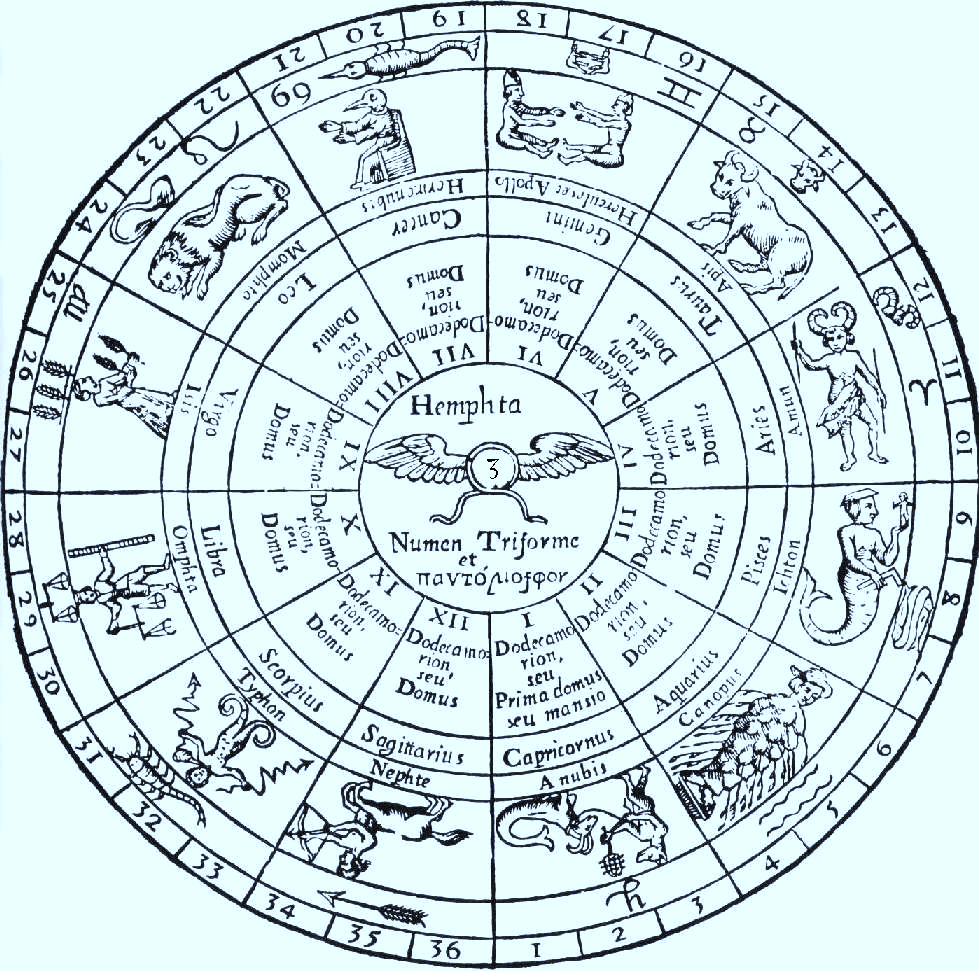
Out of this competing mixture of human experience and divine beings; of mathematics and poetry; of science and art, horoscopic astrology emerged. As groups of stars and planets were identified, the building blocks of astrology were set: the signs of the Zodiac and the planets including the Sun and Moon that traversed them. The signs and planets may have been understood to exist in a distant realm of the deities, but they manifested themselves by rising, culminating and setting within the confines of our local sky. And so, we divided the local sky and created ‘houses’ so as to know where these divine emissaries were having their effect relative to our mundane human experience. Houses are the interface between the heavens and earthly experience.
The Philosophical Basis of the World
The philosophical notion that at the beginning of time everything emanated from one pure source. Existence being the result of a Creator dreaming, thinking, or speaking us/it into being, is a thread found in the fabric of many traditions. The notion that the further one gets from the source, and the closer to physical manifestation, the more complex, changeable and corrupted3 things become.
According to Plato the world that we inhabit is but an imperfect manifestation of a greater reality consisting of non-material ‘qualities’ that combine to make up all that exists. Plato called these qualities ‘forms’ and hypothesized that these essential ‘beings’ existed in a realm that laid beyond the physical manifested world that we experience. To have knowledge of a thing according to Plato, one needed to go beyond the sensory experience of that thing and come to know the essential ‘forms’ of which it was made.
In effect the idea that our world and physical body are but imperfect reflections of the essentially pure, non-material spirit from which it is born. Our senses inform us only of the manifested and therefore imperfect material reality we inhabit. True knowledge and its ensuing wisdom can only come by piercing through the illusion of the senses and engaging our rational mind or Spirit. Without doing this we are left with mere illusion of knowledge and opinions4.
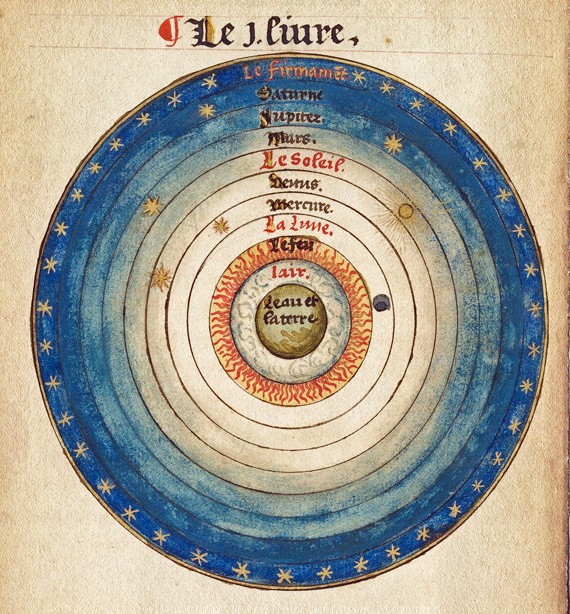
This idea was further expounded on when looking at the model of the universe according the Aristotle/ Ptolemy that puts the earth at its center, divided into the four level of the element (Fire, Air, Water and Earth) and surrounded by the seven planetary spheres, the sphere of the fixed stars and finally the Primus mobile, beyond which exists the single pure source, the one, the monad that put the whole scheme into motion5.
Houses in the astrological scheme
The astrological houses are measured from the perspective of a particular place on earth. They are a division of the sky that is measured from the ASC, the eastern point of the ecliptic, a ‘fixed’ point relative to a particular place on earth and the MC the highest point on the ecliptic. The houses map the primary motion of the Sun/ Moon and other planet’s daily journey through our skies. The relationship of the houses with the observer is altogether more personal and direct, and through them the effect of a planet in the zodiac is grounded to reveal its specific influence upon a particular place on earth at a particular moment in time. From the perspective of the Ptolemaic/Aristotelean cosmos, the doctrine of astrological houses is by definition the most ‘corrupted’ and least pure thing in our astrology. The houses are earth bound, they are created relative to a particular place on this planet; they are at once forever changing and simultaneously fixed to a place/point in the manifested world we experience.6
Houses evolved to represent areas of life and arenas of earthly, human experience. Houses reveal the stage on which the drama of human experience unfolds, and if we are being honest, we have to admit that we love a good drama.
Is it a wonder that house systems are the one area of astrology that people become attached to or in some cases reject outright, as in the case of Cosmobiology. Is it a wonder that it also the most disputed? Is it a wonder that the subject of houses causes some of the most dramatic and emotive arguments between otherwise level headed astrologers? I think not.
Choose your house system (or not), continue working with the higher beings that populate our cosmos, commit yourself to mastery, take responsibility for your words, be present and humble, but most of all, always remember that opinion is not knowledge.
- For a more thorough understanding of this see Martin Gansten’s paper on the subject https://brill.com/view/journals/ijdp/4/1/article-p1_1.xml
↩︎ - For a full breakdown of the differences in house system see Deborah Houlding’s The Houses: Temples of the Sky (The Wessex Astrologer Ltd 2006) ↩︎
- Corruption is related to the constant change of physical corporal life. All life on earth eventually dies and decays. This is the meaning of being impure and corruptible. ↩︎
- [1] The fascinating fact that Mercury is the planet that signifies astrology and is associated with the rational mind should not be lost to any of us. Its glyph incorporates: the cross of matter, the circle of spirit and the crescent of soul. ↩︎
- Some model added an extra 10th sphere between the fixed stars and the Primus mobile…that of the Zodiac. I would ascertain that this would be when the Zodiac became connected with the cardinal seasonal points and decoupled from the stars. ↩︎
- The ASC/DES and MC/IC anchor is fixed to a place on earth and will remain the same relative to that place, regardless of time or season. (If 21 Leo rises and the MC degree is 14 Taurus; every time 21 Leo rises at that place, 14 Taurus will be the degree on the MC.) ↩︎
 Astrologicalmind