Traditional astrologers viewed the planets quite differently than how we understand them today. They understood the planets to be living conscious beings, or as 12th century Guido Bonatti called them: superior beings.
“…On those things which move a man to pose a question. The first is the motion of the soul, when someone is moved by his intention to pose a question. The second is the motion of the superior beings, namely when someone asks what they are impressing into the quaesited thing, what will come of it…”1
Planets were not owned in the way we speak of them, when we claim some authority over “my Saturn” or “my Moon” … In the past each planet was understood as having a fundamental nature that dictated its specific function, promise and associated chain of correspondence. Depending on their condition at a particular moment in time, they would express the best or worst of their nature and fulfill their promise to a lesser or greater degree.
The notion of some planets being “malefic” and others “benefic” is one that sits uncomfortably with contemporary norms. Our world promotes the notion of equality and neutrality, to the detriment of natural order. Each of the seven classic planets was understood to govern an aspect of the divine order which dictated that everything in this world must be born, grow, sow their seed and die. The benefic planets were life promoting, initiating growth, birth and expansion; whereas the malefic planets functioned to restrict and destroy, ensuring that no one out stayed their allotted time. Each was crucial in maintaining balance in the world.
The human experience tends to judge one side of this balance more favorably that the other. We want to avoid the pain that comes with lose, grief and death; and to seek out that which promotes life, joy and happiness. One is brought to us via the malefic planets Mars and Saturn, while the other by the benefic Jupiter and Venus.
Who is Saturn?
Saturn rules time and the restriction this imposes on our earthly existence. As astrologers, we deal in time and are prone to get caught in its apparent, but deceptive forward momentum. However if we are to look honestly into our past, we can recognize that we have not moved far. The cycles of life, the movement of the planets and stars, mark our experiences, but time stands still in a forever present moment that is re-experienced over and over and over.
Traditional astrology understood the importance of Saturn, not only as the significator of time but also as the ally of the astrologer. For it was only through hard study and serious application to this sacred Art that any relationship with the “superior beings” (the planets) is possible.
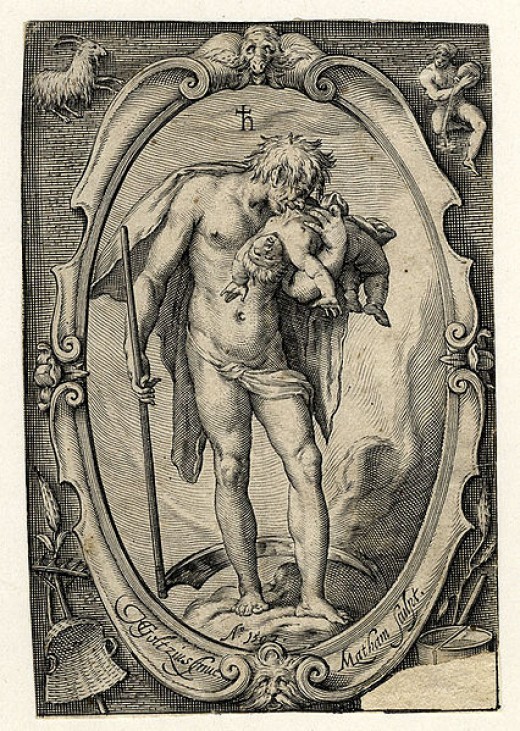
Saturn is encountered at the beginning and at the end of all endeavors, including life. He provides the body that allows us this earthly experience, and at the appropriate time, he takes it away. It is for this reason that he is associated with the ASC and 1st house, the beginning point that marks our birth; and the 8th house of death.
Saturn is the first planet in the Chaldean order, the first planetary gate through which the Soul must pass on its journey into incarnation. Encountering Saturn, the soul takes on structure and authority as well as the limitations of the physical body, matter and time. Even as modern astrologers we are well aware of the association of Saturn with restriction and limitation. The reason for this becomes obvious when we consider that Saturn exists at the outmost edge of our visible solar system, and defines our natural limits. Saturn is the border between our known world and the Divine sphere of the fixed stars.
The basic qualities that make up Saturn’s temperament are cold and dry to the extreme. Cold constricts and dry limits movement. Saturn is of a melancholic temperament; he is stern, serious and authoritative. He is a masculine and diurnal or day planet. Saturn’s extreme cold nature needs the warmth of the Sun to function in a more balanced manner, therefore though he may like and feel at home in the cold darkness of night, he functions better in the heat and light of the day.
Saturn’s extreme cold and dry nature is what accounts for his reputation as a malefic planet. The absence of warmth and moisture is antagonistic to life and growth. Yet it is these qualities of Saturn that allows matter to crystallise and take physical form. It is the discipline and structure of Saturn that allows life to exist and ideas to take shape. From a human psychological perspective, it is only when we engage with the discipline and structure of Saturn that we accomplish anything.
The tears of grief are another of Saturn’s gifts to the soul. Hidden deep in Saturn’s strictness and authority lays the impossible longing for the return to the divine. The grief of Saturn is the knowing that one must pass through incarnated life, with its pain and joys and that one’s authority is fleeting and illusionary. The ruins of the past, the laws of old, and the desolation of yesterday are all part of Saturn’s cold and dry rule; and so, his association with melancholy and in its extreme form, depression.
The great malefic demands hard work and is associated with death and the inevitable end to all beginnings. Interestingly he is also connected with births, to which death is always a close possibility. This is illustrated by the fact that the birthing process is called “labour”, for it is indeed hard work to give birth and hard work is Saturn’s territory.
From a traditional medical understanding Saturn governs the memory function of the “animal spirit” which resides in the brain. Without Saturn our individual thoughts and knowledge could not be retained. Saturn is the storehouse of wisdom.
Saturn is associated with the hardest, heaviest and oldest things. He is associated with old age (from 70 to 99 years old) and the seventh age of man, the age of resignation and ideally, wisdom. Saturn is associated with the metal lead, the heaviest and most poisonous of all the metals. Saturn corresponds to the most toxic and poisonous plants, including hemlock and belladonna.
Saturn is said to rule the bones, teeth and skin of the body, that which defines the structure and limits of the physical body. All boundaries are under the rule of Saturn. At the borders of our travels, we encounter Saturn in the form of immigration and border authority which demands that we present our documents, our right to passage, or we can go no further.
No need to fear the great malefic?
Once we enter the world of traditional astrology our view of life and reality changes. Once we open our minds to the wisdom of our lineage, it is very difficult not to be influenced by the great astrologers that came before us. However, it is the incredible commonality between human experience of the past and our own that takes us by surprise. The emotional and psychological needs of the everyday person have not changed over the centuries, even though our technology has.
We live in a linear world that is imbued with the ideas that promote evolution and progress. Whilst everything on earth is born, grows, withers and dies in the endless cycle of life, giving rise to the illusion of a forward movement of time, it is but that; an illusion.
Saturn is the path less taken, because it is the path of greatest hardship; the path of blood, sweat and tears. Saturn provides us with challenges and obstacles that in the end force us to confront the inevitable transient nature of life. Saturn teaches us that this life is an illusion to which we are not meant to get attached. But by making the effort to befriend Saturn and do the hard work he requires, we are rewarded by the awe-inspiring storehouse of ancient wisdom that is his domain; and by making friends with Saturn the door is open to the other superior beings in our cosmos: Jupiter, Mars, Mercury, Venus and the Luminaries.
- Guido Bonatti Book of Astronomy – Treatise 5: 146 Considerations translated by Benjamin Dykes ↩︎
 Astrologicalmind
Leave a comment