EVIL • adjective 1 deeply immoral and malevolent. 2 embodying or associated with the devil. 3 extremely unpleasant: an evil smell. • noun 1 extreme wickedness and depravity, especially when regarded as a supernatural force. 2 something harmful or undesirable.
In religion and ethics, evil refers to the “bad” aspects of the behaviour and reasoning of human being – those which are deliberately void of conscience, and show a wanton desire for destruction. The opposite of goodness, which itself refers to aspects which are life-affirming, peaceful, and constructive.
Can evil be seen in a chart? Do certain individuals choose to be evil or are they fated to be so? And do their charts reflect this? And are we fated to live out what is in our chart? These questions are all loaded and profoundly disturb many in our profession.
In this day, when even the ancient descriptions of planets as benefic and malefic elicits discomfort in contemporary astrologers, it is no longer regarded as correct to think in these terms. The idea that a planet or person could be inherently bad goes against our accepted standard of judgment. Deviation from acceptable behaviour is seen as an understandable reaction to the emotional and psychological experiences that have traumatized or otherwise wounded individuals.
Ironically as we move away from judging an individual as evil we continue to embrace the idea that evil exists in the world. As illustrated by our “war on terror” and our fear of the “terrorist threat”. The concept of evil has always been present but we have confused the doing of evil with being evil.
When our ancestors spoke of a planet bestowing malevolent or benefic influence in a horoscope, we tend to imagine this as being a very cut and dry affair: bad planet cause bad things, good planet, cause good thing. The reality is far richer and more subtle than it appears at first glance.
The Malefic Planets: Mars & Saturn
In the traditional cosmos the so-called malevolent planets were Mars and Saturn. At their best both are a necessary and positive force in the chart, allowing us to take righteous action, be responsible and build strong foundations. Both have ‘jobs’ related to ending and death. When these planets were afflicted, they went out of balance and their influence becomes negative and destructive.
A planet is at its best when in essential dignity and with some reception. A debilitated planet has a really hard time expressing its true nature; they become an exaggerated or distorted version of themselves. Mars doesn’t just take action; he kills all who stand in his way. Saturn doesn’t just take responsibility he becomes tyrannical. The other planets can also cause trouble when in a debilitated condition, but their effect is unlikely to be thought of as evil.
Whether fate is pre-destined or created by the native’s choices is a tricky one. The modern paradigm places more emphasis on the free will and choice of the individual then was the case in the past. In previous generations the individual had their place within the social hierarchy and few had any choice about it. Even those at the top of this hierarchy had limited choices. Overseeing all, there was God.
Now we may speak of the higher self rather than God. Many have become uncomfortable with the concept of a Supreme Being overseeing us all, choosing for us, and allocating our fate. The concept of the “higher self” individualises us, if not in fact certainly in title. It allows us the illusion of having more power to choose. Regardless of our modern belief in the importance of the individual, fate can not be denied; it is what is bestowed on us.
We are born into a certain era or time, a particular body, gender, to a particular set of parents, within a family, culture and nation. We do not consciously choose this; we are given this. This is fate. Our free will to choose is confined to limits of our given fate. Man’s essential nature is both corporeal and spiritual; the integration of these polarities draws us closer to our essential nature. Essential nature by definition signifies a more balanced state of being. A state more aligned with the Divine, however we define that word.
In nature a daisy will grow into the best daisy specimen possible within the environment it is given. It can not do otherwise or choose to grow into a rose. Because nothing in the natural world can stray from its essential nature, there is no evil there. A volcano may cause devastation, cruel as this may seem, it is nothing more then the restoration of balance. Nature has no will to choose otherwise. But the human being has free will to choose and can turn away from his essential nature. He must come to know and accept who he is, what he has been given, understand his purpose in the scheme of things and fulfil it. The further away from his essential nature he moves the more he encounters evil or in the words of our fore bearers; malevolence.
The principal thing that pushes man away from his essential good nature is his desires; desire that stem from his corporeal existence. His desire to possess more than what he has been given, to have more power than he needs and to strive for a purpose not of his own. In modern jargon these corresponds to the ego and remember that the ego is never satisfied.
The Lord of the Ascendant, Pilot of the Soul and
The Significator of the Quality of the Mind
Using traditional astrological methods, we can see in the natal chart how easy or not it will be for an individual to stay aligned with his true nature and how strong the pull of his desires will be. By identifying three planets: the Lord of the Ascendant, the Pilot of the Soul and the significator of the Quality of the Mind, we have the information needed to judge how likely one is to move towards or away from his/her essential nature.
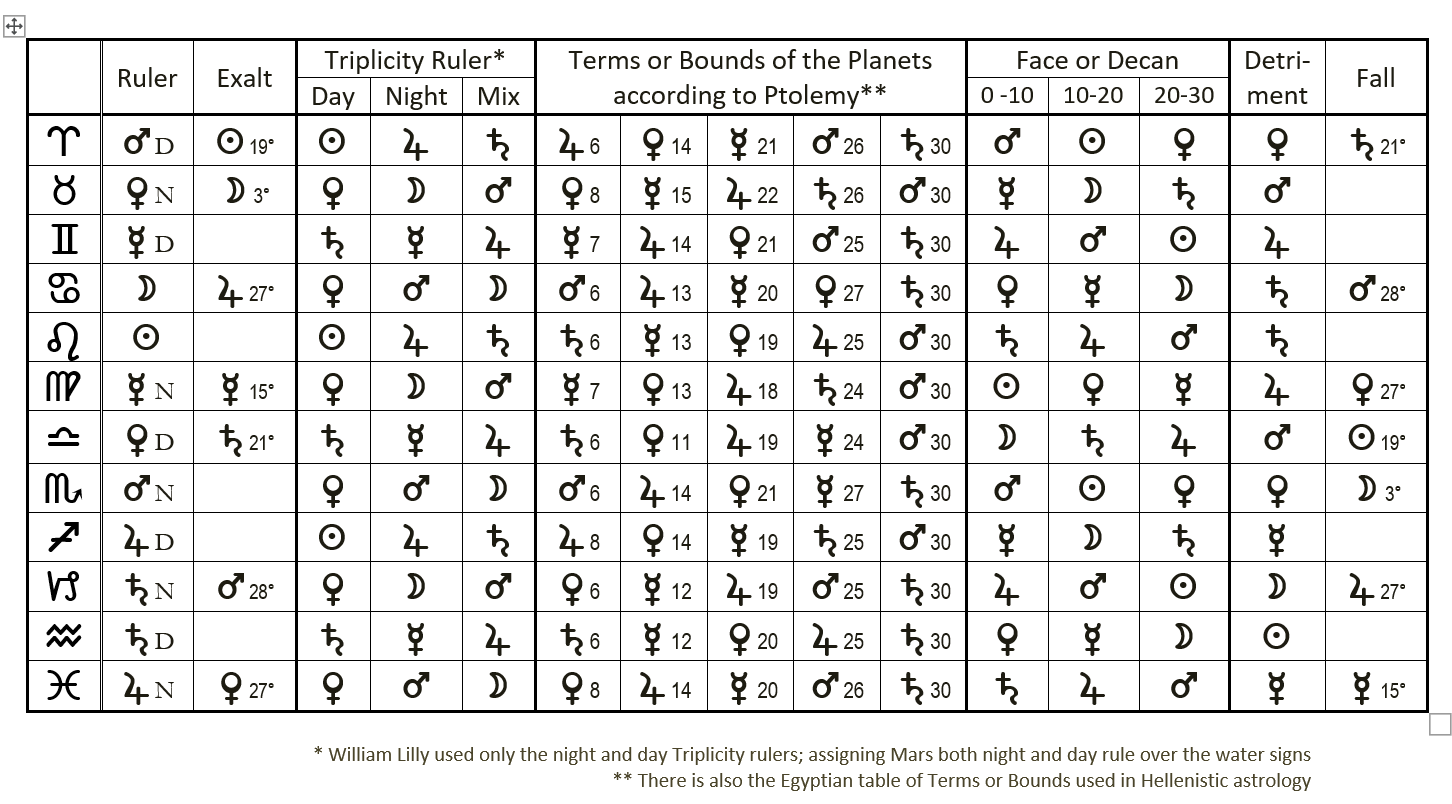
To find these planets we use the table of essential dignities to calculate the almuten (overall ruler) of particular degree of the zodiac. Giving the planet in rulership 5 points, in exaltation 4 points, in triplicity 3 points, in term 2 points and in face 1 point, we simply add up the points for each planet to find the one with the most essential dignity at a particular degree or degrees. It is important to note whether it is a day or night chart and use the appropriate triplicity ruler.
The Lord of the Ascendant is the planet which has the most essential dignity at the ASC degree, in other words the almuten of the ASC. Often this is the planet ruling the ASC but not always. As the overall ruler of our ASC this planet is most concerned with our corporeal life; the driving force that motivates us. In modern jargon we could say it signifies our ego.
The Pilot of the Soul, is the planet with the most essential dignity overall; and in the strongest position, in the chart. Ideally it would also be free of accidental debility such as retrograde or combustion. The Pilot of the Soul is the planet that would ideally take charge. This is the planet that could set us on the right path and redirect us if we get side-tracked. This is the planet most closely aligned to spirit; most connected to Divine source. This is the planet we should endeavour to engage and make friends with, for it is most likely to raise us above our corporeal fate.
Finally, we find the significator of the Quality of the Mind by finding the compound almuten; the planet with the most essential dignity at the degrees of the Moon, Mercury and ASC. Quality of the mind does not refer to intelligence, but rather to how and to what purpose the mind is used. It relates to conscience and the moral nature of the native. This planet represents the balance between their sensible and rational minds and how well their corporeal and spiritual facets integrate. In other words, do they use their mind for good or evil?
 Astrologicalmind
Leave a comment